

Seedlings Damping Off? Do This Right Now
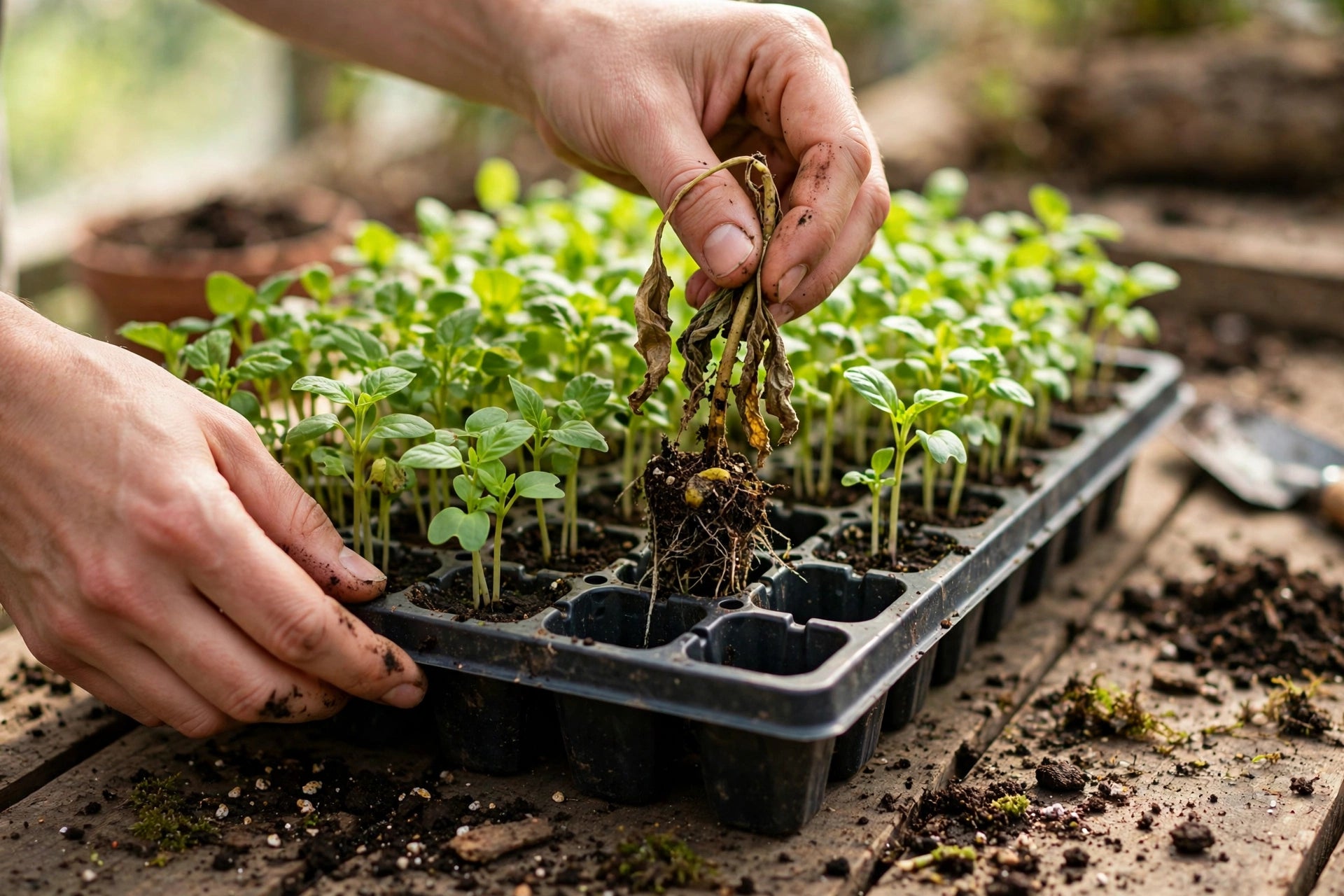
Your seedlings were fine yesterday, and this morning several have toppled over with pinched, brownish stems at the soil line. That is almost certainly damping off, and the most important thing to know is this: the collapsed seedlings cannot be saved, but the rest of the tray often can — if you act within the day. Work through these five steps in order: confirm what you are seeing, remove the infected seedlings immediately, stabilize conditions for the survivors, decide whether to restart the batch, and set up prevention so the next sowing does not repeat the loss.
Step 1: confirm it looks like damping off
Before you tear apart a tray, take two minutes to check the symptoms. Gently examine the fallen seedlings: damping off shows a narrowed, water-soaked, brown-to-dark stem right at or just below the soil surface — the stem looks pinched, as if someone squeezed it. The seedling above the pinch often still looks green and healthy, which is why the collapse feels so sudden.
Compare with the alternatives. If stems are intact but leaves are yellowing and the soil is soggy, you are more likely looking at overwatering — see damping off vs overwatering: how to tell apart for the full side-by-side before you act. If seedlings are tall, pale, and floppy without any stem lesion, the problem is weak light, not disease. And if nothing sprouted at all, the seeds may have rotted before emergence (pre-emergence damping off) or simply been non-viable — our guide to seeds rotting before germination covers that case.
If the pinched stem is there, proceed. Speed matters now: damping off can move across a tray in a couple of days under warm, damp conditions.
Step 2: remove every affected seedling — now
This is the step people resist, and it is the most important one. There is no cure for a seedling with damping off. No spray, no rescue watering, no amount of hope will restore a girdled stem. Every infected seedling left in the tray is a source of spores threatening its neighbors.
Pull each collapsed or pinched seedling out completely, roots and all — tweezers help with tiny cells. Be gentle enough not to shower soil onto neighboring seedlings, since the pathogens travel in soil and water splash. Drop the removed seedlings straight into the trash or a sealed bag, never into the compost pile, where the fungi will survive and return to your garden later. Wash your hands and the tweezers before handling the healthy seedlings.
While you are at it, thin the tray. Crowded seedlings trap humid air around their stems, so if cells hold multiple sprouts, snip the extras at the soil line with clean scissors rather than pulling them (pulling disturbs neighbors' roots). Good spacing is a mechanical control — simple, immediate, and effective.
Step 3: stabilize the survivors
With the infected seedlings gone, change the conditions that let the fungi win. Work through these cultural fixes in order:
Dry the surface. Stop top-watering immediately. Let the top of the mix dry out between waterings, and switch to bottom-watering: set the tray in a shallow pan of water for 10 to 15 minutes so moisture wicks up from below, keeping the stem zone drier. Damping-off fungi need sustained surface moisture; a dry surface is hostile ground for them.
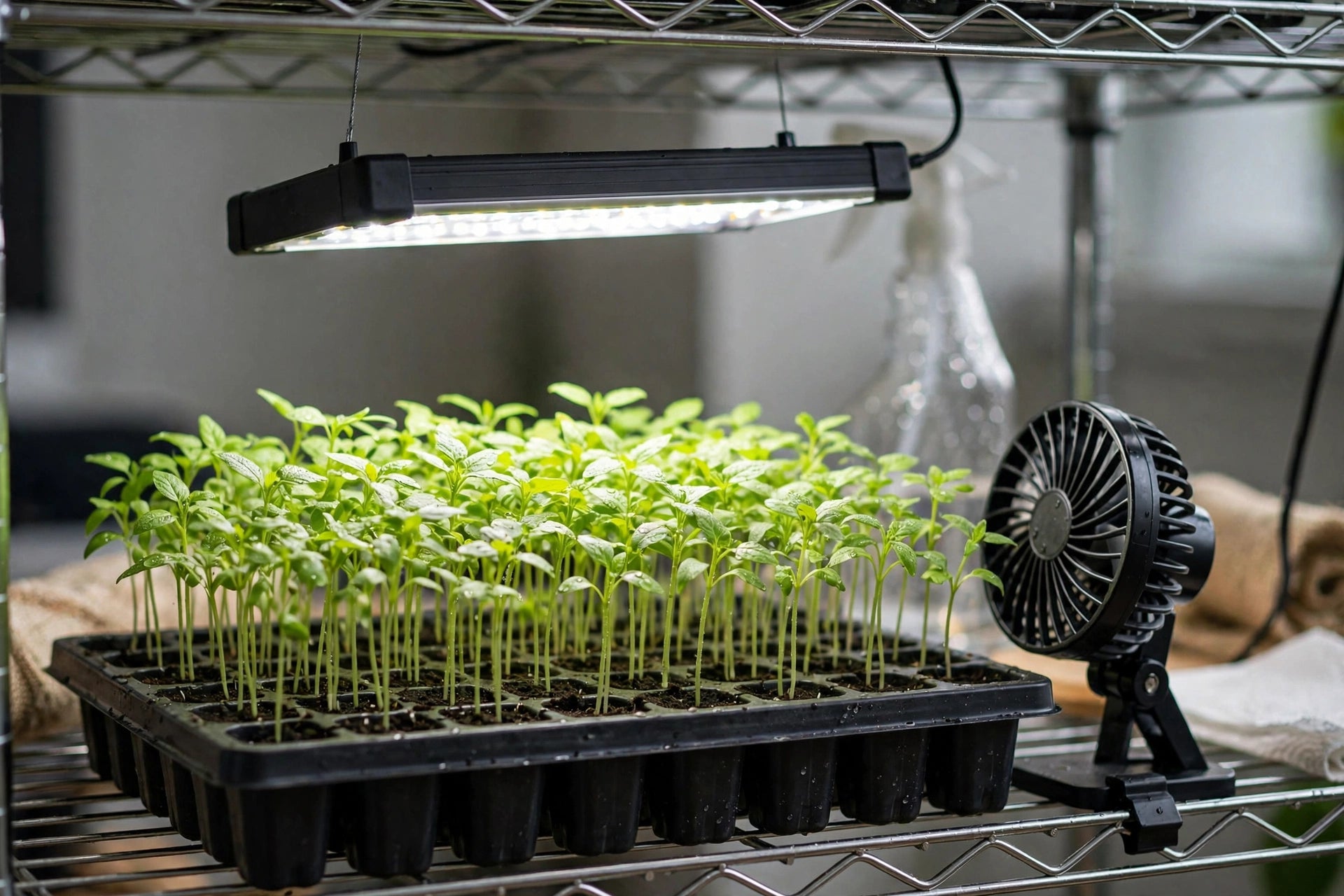
Add air movement. Set a small fan a few feet from the tray on its lowest setting, aimed so seedlings tremble rather than bend, and run it during daylight hours. Moving air evaporates surface moisture and strengthens the survivors' stems. The full setup is detailed in best airflow for seedlings: fan setup that works.
Give more light. Move the tray to the brightest spot available or lower the grow light to a few inches above the leaves. Strong light dries the surface faster and grows sturdier stems that resist infection.
Warm the roots if they are cold. If the tray sits in a cool room or on a cold windowsill, soil below about 65°F slows seedling metabolism and keeps the mix damp longer. A heat mat under the tray helps — but remove it once seedlings are up and growing, since they prefer cooler air after emergence.
Do not reach for fungicides at this stage hoping to cure the tray. Products labeled for damping off are preventive — they protect healthy seedlings, they do not heal infected ones — and with the cultural steps above, most home trays recover without chemicals. That is IPM in the correct order: sanitation and removal first, cultural controls second, and stronger measures only if the situation truly warrants them and the label allows.
Step 4: decide — nurse the tray or restart?
This is a judgment call, and here is how to make it calmly. Nurse the tray if: fewer than about a third of the seedlings are affected, the survivors look vigorous with firm green stems, and you have at least three to four weeks before your transplant date. A thinned, dried, fanned tray often stabilizes within days and goes on to produce fine transplants.
Restart the batch if: more than half the tray collapsed, the survivors are weak and stalling, or the disease keeps appearing in new cells despite your fixes. Restarting feels like defeat, but a fresh sowing in clean conditions will almost always outpace a sickly tray — and it costs you a packet of seed and a week, not the whole season. If you restart, do not reuse the mix or the unwashed tray: discard the mix (or heat-sterilize it — see how to sterilize seed starting mix), wash containers, and rinse with a 1 part bleach to 9 parts water solution before refilling.
Timing matters by region. In the South and warm coastal zones with long seasons, restarting in March or April costs little. In northern zones with short summers, check your last-frost date: if restarting still leaves six to eight weeks before transplant time for that crop, go ahead; if not, nurse the survivors and consider buying a few nursery transplants to fill the gap. There is no shame in that — it is good garden management.
Step 5: prevention checklist for the next sowing
Whatever you decide, make the next sowing the one that does not get sick. Run through this checklist before seeds touch mix:
- Start with fresh bagged mix, or sterilize reused mix at 180–200°F for 30 minutes and let it cool fully. - Wash trays and tools; rinse containers in a 1:9 bleach solution and air-dry. - Sow at the correct depth — about twice the seed's width; press tiny seeds onto the surface. - Water from the bottom, and let the surface dry between waterings. - Remove humidity domes at sprouting; run a small fan on low during the day. - Give 14 to 16 hours of strong light, positioned close above the tray. - Keep soil at 65–75°F for germination; avoid cold windowsills at night. - Thin to one strong seedling per cell early, before crowding traps humidity.
Each item is small; together they remove every advantage damping-off fungi depend on. The complete disease background lives in our damping off guide, and if your diagnosis was uncertain, seedling stems turning brown walks through the other causes of stem discoloration.
A fan, a thermometer, and a watering tray are the whole toolkit for the rescue — practical versions of all three are listed with other gardening tools on our tools page. Whether you are growing vegetables for the table or flowers for the vase, the triage is the same.
Frequently asked questions
Can I save a seedling that has already collapsed from damping off? No. Once the stem is girdled at the soil line, the seedling cannot transport water and will not recover. Remove it promptly so it does not infect its neighbors, and focus your effort on protecting the healthy seedlings.
How quickly do I need to act? Within the same day you notice it. Damping off spreads fast in warm, damp conditions — a tray can lose most of its seedlings in a few days. The removal and drying steps take less than half an hour and make the biggest difference.
Should I throw away the whole tray? Only if most seedlings are affected or new collapses keep appearing despite fixes. If the majority look healthy with firm stems, remove the sick ones, apply the cultural fixes, and monitor daily. A partial loss is a normal setback, not a total failure.
Will cinnamon, chamomile tea, or hydrogen peroxide cure damping off? These home remedies are widely discussed online, but none reliably cures an infected seedling, and extension sources do not recommend them as treatments. They are no substitute for removing infected plants and fixing moisture and airflow. Spend your energy on the proven steps instead.
Can damping off spread to my houseplants or garden? The pathogens are soil-borne and spread mainly through contaminated mix, water splash, and tools — not through the air across the room. Keep the tray isolated from other seedlings, wash your hands and tools after handling it, and do not compost infected material, and your other plants will be fine.
When is it safe to start a new batch after damping off? Immediately, as long as you do not reuse the contaminated mix or unwashed containers. Sterilize or replace the mix, sanitize the trays, correct the watering and airflow setup, and sow fresh. Many growers get a clean second sowing in the same week.
Sources
- UC Integrated Pest Management — damping-off identification, sanitation, and cultural controls - Utah State University Extension — damping-off causal agents, symptoms, and moisture management - Penn State Extension — damping-off disease spread and seedling susceptibility conditions - LSU AgCenter — damping-off triage, integrated management, and preventive fungicide guidance
Wrapping things up!
Finding collapsed seedlings is upsetting, but you are not helpless and you are not starting from zero. Pull the infected ones, dry the tray, add air and light, and decide calmly whether to nurse or restart. Most growers who act the same day save the majority of the tray.
Damping off punishes still, soggy, crowded conditions — so every fix you just made is also prevention for every tray you will ever start. That is the silver lining: this one bad morning makes you a better seed starter for years.
