Best Airflow for Seedlings: Fan Setup That Works
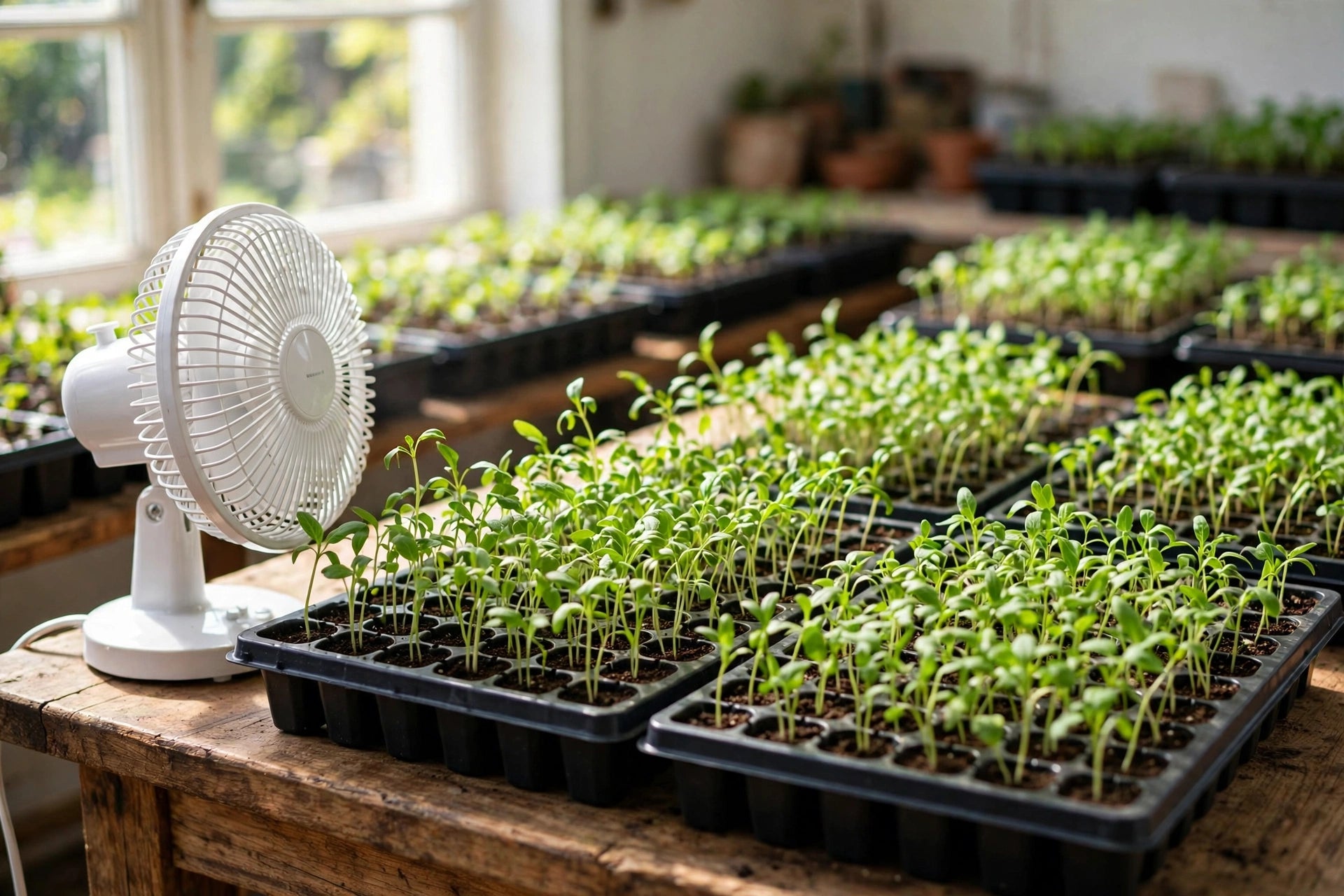
The best airflow for seedlings is a small oscillating fan on its lowest setting, placed a few feet from the tray and aimed so the air just makes the seedlings tremble — not bend. Run it for a few hours a day, and you get two benefits at once: the moving air dries the soil surface where damping-off fungi attack, and the gentle mechanical stress triggers thigmomorphogenesis, the plant's touch-response that builds shorter, stockier, stronger stems. It is the cheapest upgrade in indoor seed starting, and it prevents more problems than almost any gadget on the shelf.
Why still air hurts seedlings
Indoors, the air around a seedling tray barely moves. That still layer does two kinds of damage. First, it keeps the soil surface damp for hours after watering, which is exactly the condition Pythium and other damping-off pathogens need to infect the stem at the soil line. Second, seedlings grown without any air movement never experience the mechanical stimulation of wind, so they grow tall, thin, and weak — the classic leggy windowsill seedling that flops over at transplant time.
Outdoor seedlings get wind for free, and wind is a training program: every gust bends the stem slightly, and the plant responds by laying down thicker cell walls and more supportive tissue. Indoor growers have to supply that training artificially. A fan does it, and unlike brushing seedlings by hand, it works while you are at work.
The setup: fan type, distance, and aim
You do not need a special grow-room fan. A small oscillating desk fan or clip-on fan on its lowest speed is ideal, because the goal is a whisper of movement, not a windstorm. Place it two to four feet from the tray — far enough that the breeze arrives softened — and aim it slightly above the seedlings or at a nearby wall so the air reaches them indirectly rather than blasting one corner of the tray.
Oscillation matters more than power. A fan that sweeps back and forth gives every seedling intermittent movement from changing angles, which mimics natural wind far better than a constant stream from a fixed fan. If your only fan is strong, point it away from the tray entirely and let it stir the room air; even general circulation helps. Watch the seedlings for the first hour: leaves should flutter and stems should tremble. If seedlings are bending sideways or the soil surface is visibly rippling, the fan is too close or too strong — move it back.
For large shelving setups, one small fan per shelf or per pair of trays is a good rule of thumb. Clip-on fans are handy here because they attach to the shelf upright and stay aimed where you put them; several practical options are listed with other seed-starting tools on our gardening tools page.
How long to run it each day
Start the fan as soon as seeds sprout — there is no benefit to fanning bare soil, and tiny just-emerged seedlings are the most vulnerable to being dried out. Begin with a few hours a day and build up to most of the daylight hours as the seedlings develop their first true leaves and sturdier stems.
A timer makes this effortless: set the fan to run during the hours your grow lights are on, and let it rest at night when the lights are off. Constant 24-hour airflow is unnecessary and dries the mix faster than most growers expect, so a day-on, night-off rhythm is the sweet spot for most trays. In very humid rooms or during damp spring weather, longer run times help keep the soil surface in the dry zone that damping-off fungi hate.
Thigmomorphogenesis: the science behind sturdier stems
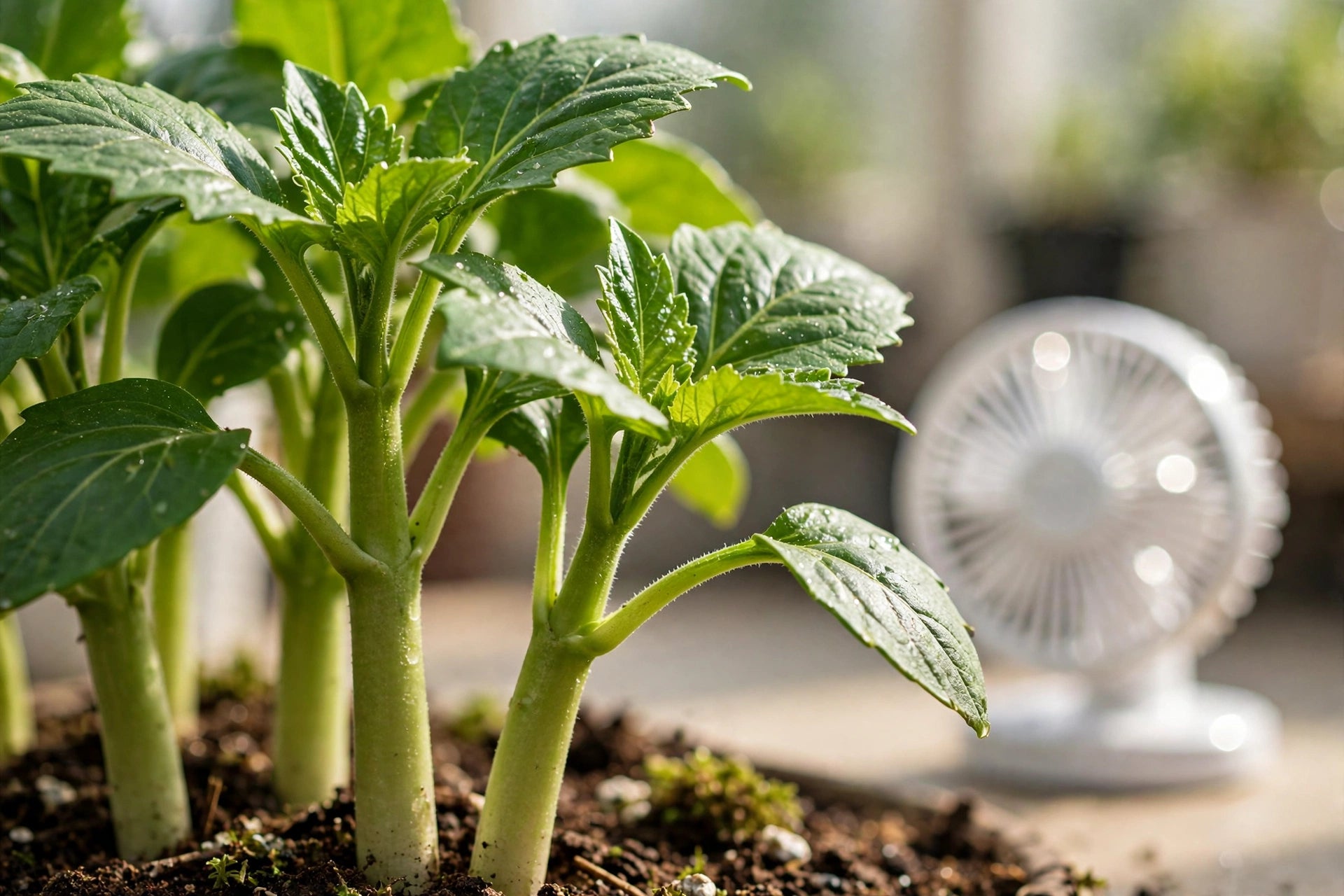
Thigmomorphogenesis is the plant's growth response to mechanical stimulation — touch, wind, rain, vibration. When a seedling's stem is repeatedly bent by moving air, the plant shifts resources into shorter, thicker growth: stems grow stockier, leaves grow smaller and darker and sit closer together, and supportive tissue increases. Studies on garden species from tomatoes to marigolds have shown mechanically stimulated seedlings can show substantially reduced stem elongation compared with still-air controls.
This is not just cosmetic. Stocky seedlings transplant better, resist wind damage outdoors, and — relevant to this whole article cluster — their thicker stem bases are less easily girdled by damping-off fungi. The fan is simultaneously a disease-prevention tool and a strength-training program. Horticulture references have recommended this practice for decades: the classic advice is that airflow should make seedlings vibrate or wiggle, never bend, and that growers should water more attentively because moving air dries the mix faster.
Hand-brushing is the manual alternative: drawing a folded piece of paper lightly across the seedling tops once or twice a day, bending them gently and letting them spring back. It works, but the fan is more consistent and covers every tray at once.
Airflow as damping-off prevention
Damping-off fungi thrive in still, humid air over wet soil. A fan attacks that microclimate directly: it evaporates surface moisture faster, keeps humidity from pooling around the stems, and strengthens the very tissue the fungi try to penetrate. It does not replace the other cultural defenses — sterilized starting mix, bottom-watering, and letting the surface dry between waterings — but it is the piece most indoor growers are missing.
Place airflow in its proper IPM order: prevention first (clean mix, clean containers), cultural controls next (proper watering, good light, and this fan), and only then consider anything stronger. No fungicide is needed for a tray with clean mix, careful watering, and moving air. If damping off has already appeared, see what to do when seedlings damp off — the fan then becomes part of the rescue plan for the survivors rather than a cure for the infected.
Common fan mistakes
The most common error is too much wind: a fan on high, inches from the tray, desiccates tiny seedlings faster than their immature roots can supply water, and the grower mistakes the resulting wilt for underwatering and soaks the tray — creating the wet conditions damping off loves. Gentle is the whole game.
The second mistake is fanning a tray that is already too wet instead of fixing the watering. Airflow helps a properly watered tray dry at a healthy pace; it cannot rescue a swamp. If the surface never dries, reduce watering first.
The third is forgetting that moving air increases water demand. Check trays daily once the fan is running, and expect to water somewhat more often — bottom-watering keeps the supply even. Finally, do not aim the fan at seedlings under a humidity dome; domes should come off at sprouting anyway, and trapped humid air plus a fan just circulates the problem.
A note on climate and region: growers in humid regions — the Southeast, the Gulf Coast, the Pacific Northwest in spring — gain the most from added airflow, because ambient humidity keeps tray surfaces damp far longer there. In arid climates the fan still strengthens stems, but watch watering closely since dry air plus moving air can desiccate trays in a single day.
Whether you are starting vegetable seeds for the kitchen garden or flowers for the cutting bed, the routine is the same: lights on, fan on low, water from below, and let the seedlings train against the breeze. Full background on the disease this prevents is in our damping off guide.
Frequently asked questions
Can a fan be too strong for seedlings? Yes. If seedlings bend sideways, lean permanently, or the soil surface ripples, the airflow is too strong. Move the fan farther away, switch to the lowest speed, or aim it at a wall so only indirect air reaches the tray.
How many hours a day should the fan run? A few hours daily is enough to start, building up to most of the daylight hours as seedlings develop true leaves. Running it on a timer alongside your grow lights — on during the day, off at night — is the simplest reliable schedule.
Will a fan dry out my seedling trays? It will dry them faster than still air, so check moisture daily and expect to water more often. Bottom-watering keeps moisture even. This faster surface drying is actually part of how the fan prevents damping off.
Is a ceiling fan enough, or do I need a desk fan? A ceiling fan on low helps general room circulation, but a small fan a few feet from the tray delivers the direct gentle movement that triggers the stem-strengthening response. For best results, use a dedicated small fan at tray level.
Should I run the fan before seeds sprout? No benefit and some risk — fanning bare soil just dries the surface where seeds are trying to germinate. Start the fan when the first seedlings emerge and increase run time as they grow.
Does brushing seedlings by hand work as well as a fan? Brushing lightly once or twice daily does trigger the same strengthening response and is a fine supplement. The fan wins on consistency: it treats every seedling evenly for hours without you remembering to do it.
Sources
- UC Integrated Pest Management — damping-off cultural controls including air circulation and moisture management - Cornell Cooperative Extension — indoor seedling care, air movement, and transplant vigor - Utah State University Extension — damping-off prevention through uniform moisture and environmental management - Penn State Extension — damping-off disease conditions and seedling susceptibility factors
Wrapping things up!
A five-dollar fan on low is one of the highest-return investments in seed starting: drier soil surfaces that discourage damping off, plus stockier stems built by the plant's own touch-response. Set it a few feet away, let the seedlings tremble rather than bend, run it on a timer with your lights, and water a little more attentively.
Your seedlings cannot go outside to meet the wind, so bring a gentle version of the wind to them. Come transplant day, the difference will be obvious in every thick, sturdy stem.