Slugs & Snails: Garden Damage, Identification & IPM Guide
By Paul Smith, pemdasgarden.com
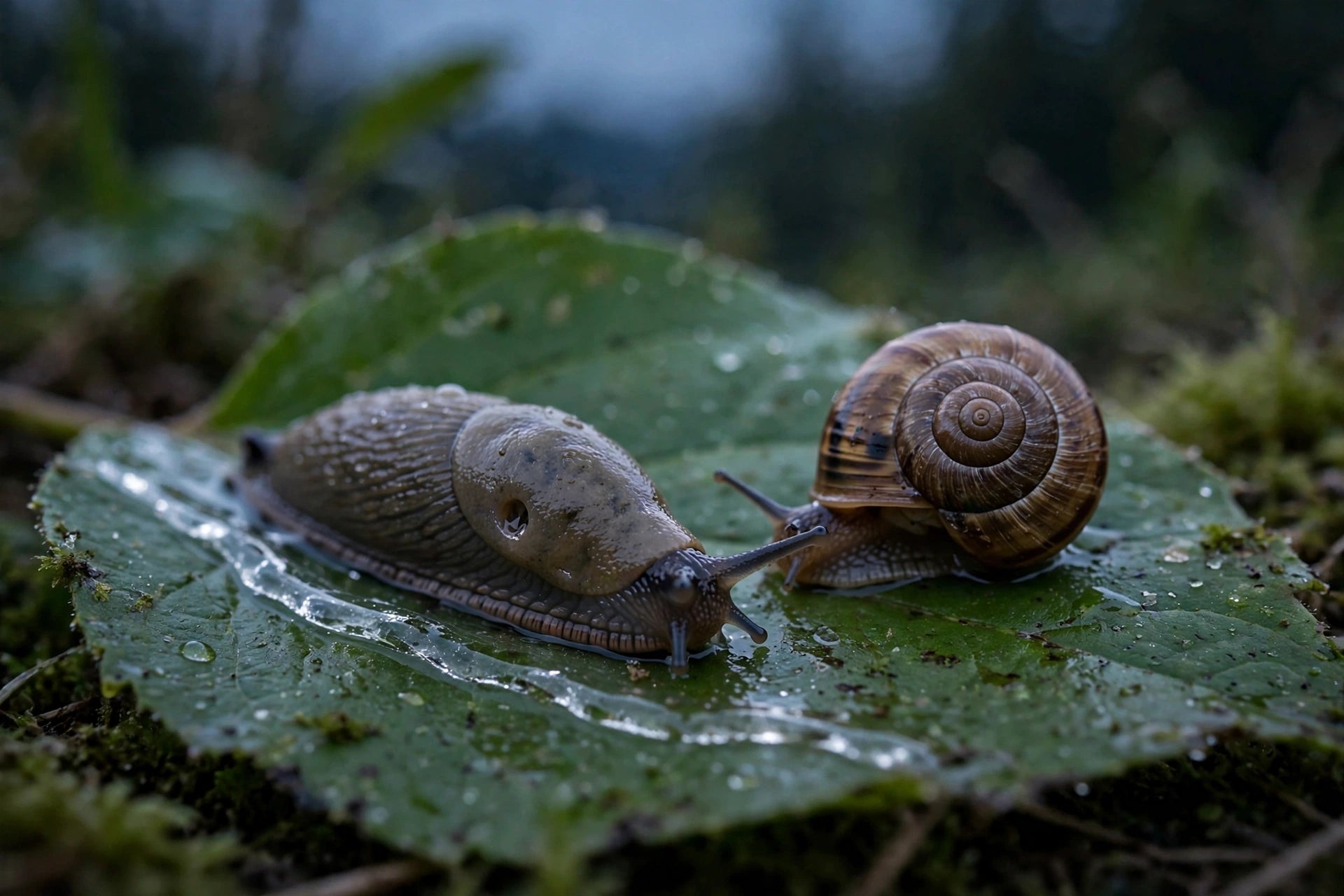
If your seedlings vanished overnight and you found silvery trails across the soil by morning, this looks most like slugs or snails — but earwigs, cutworms, and pillbugs can produce similar overnight damage, so a flashlight check after dark is what confirms it. Slugs and snails are the classic nocturnal garden feeders: soft-bodied mollusks that rasp away tender leaves, chew seedlings off at the base, and leave behind the one clue almost nothing else makes — the slime trail.
This guide is the pillar of our slugs-and-snails cluster. It covers identification, the three damage signatures, which crops take the worst hits, and a full IPM control plan in the proper order: cultural fixes first, physical and mechanical controls next, biological allies after that, and least-toxic chemical options only as a last resort. You will find a comparison of the main control methods with a clear verdict, plus an original compiled table ranking common crops by slug-damage risk so you can prioritize your defenses.
What slugs and snails actually are
Both are terrestrial mollusks, close relatives that feed with a file-like tongue called a radula. The practical difference is simple: slugs have no external shell (some carry a tiny internal remnant), while snails carry an obvious coiled shell they can retreat into. Everything else about their habits — night feeding, moisture dependence, slime trails, rasped holes — is essentially the same, which is why control strategies work for both.
They are most active on damp, overcast days and through the night, and they shelter by day under boards, pots, mulch, stones, and dense foliage. Knowing this schedule is half the battle: nearly every effective control targets their movement between shelter and food, after dark or just after watering.
Slug vs snail damage: telling them apart
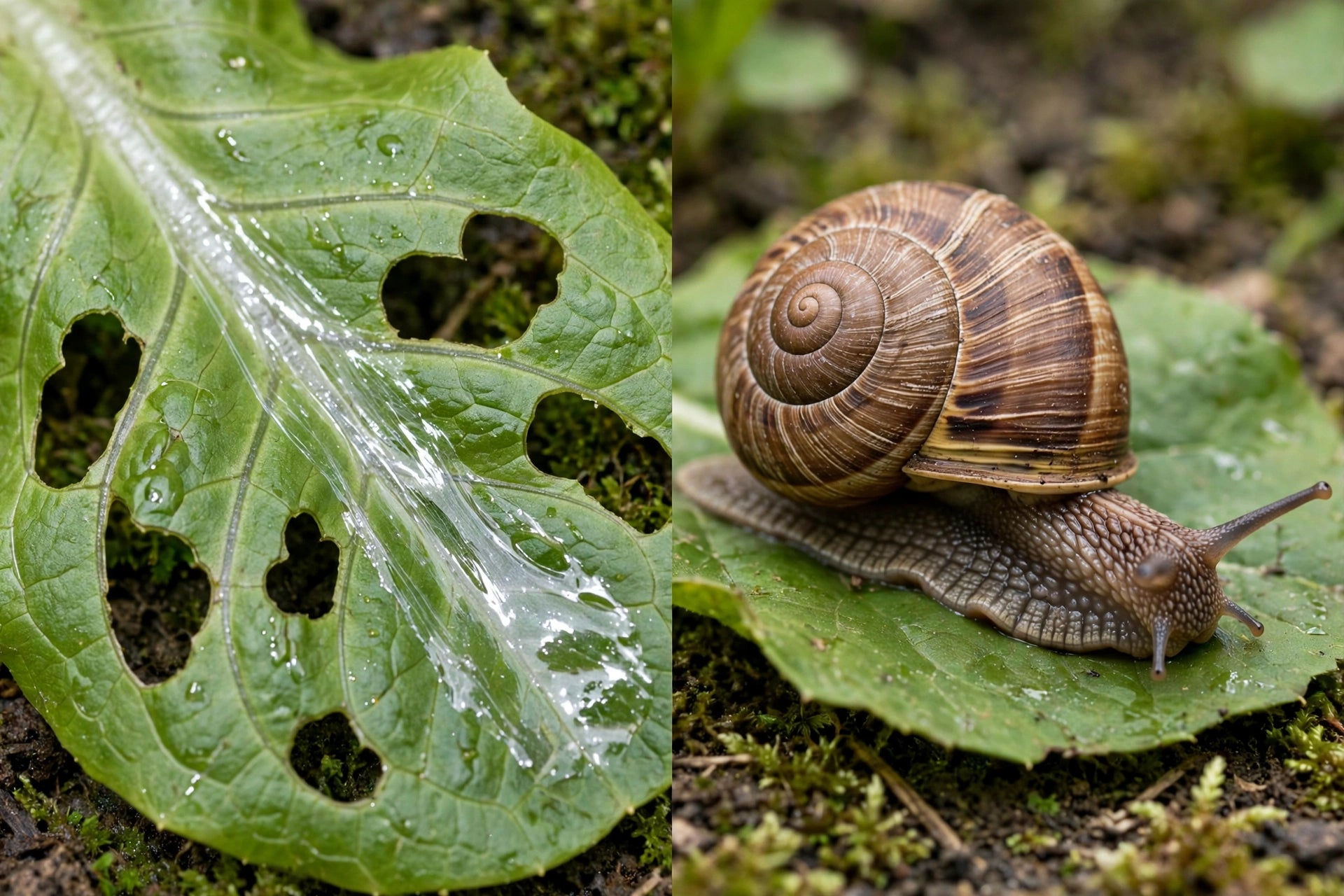
Slugs and snails make the same kind of holes, but they differ in where they hide, how their trails look, and which controls hit them hardest. Read the table, then match what you are actually seeing in your garden — and keep the uncertainty rule in mind: trails and holes alone rarely prove which one did it, because snails often feed and leave for shelter before morning. This looks most like slug damage when the trails are thin and no shells turn up anywhere nearby — but snail damage is also possible, especially around pots, walls, and paths.
| Feature | Slug | Snail |
|---|---|---|
| Shell | None — soft, elongated body, fully exposed | Coiled external shell it can seal and retreat into |
| Daytime hideouts | Soil crevices, under mulch and debris, bases of dense foliage | Under pots, boards, and stones; seals its shell opening in dry or cold weather |
| Slime-trail appearance | Thin, faint trails on soil and lower leaves; easy to miss once dry | Wider, more obvious trails, often on paths, pot rims, and walls |
| Damage pattern | Irregular smooth-edged holes, seedlings chewed at the base | Same rasped holes, but also on higher foliage and containers snails can climb in dry weather |
| Egg clusters | Small translucent, jelly-like eggs laid in moist soil and under debris | Small round, pearly-white eggs laid in moist soil and under debris |
| Barrier vulnerability | Dries out fast — copper tape and gritty barriers work by direct body contact | Shell gives some protection, but the exposed body still reacts to barriers it must cross |
| Handpicking payoff | Night flashlight sweeps pay off most; daytime finds are fewer | Daytime handpicking under pots pays off fast — each snail removed is one less breeder |
| Speed of spread | Colonizes new beds quickly in wet weather | Slower colonizer, but individuals live longer and return to the same shelters |
Verdict — choose slug-focused tactics if… you find thin trails and fast-spreading damage with no shells anywhere: slugs are the more numerous, harder-to-exclude feeder, so lean on evening watering shifts, board traps, and night sweeps. choose snail-focused tactics if… you keep turning up coiled shells under pots and boards: snails are slower to spread and easy to catch by day, so handpicking and raising pots off the ground pay off fastest.
One honest caveat: if the damage matches but you never catch the feeder, run the evening slug census below rather than assuming. A confident-sounding guess is how gardeners waste a season treating the wrong pest — the census tells you what is actually out there.
Reading the damage: the three slug-and-snail signatures
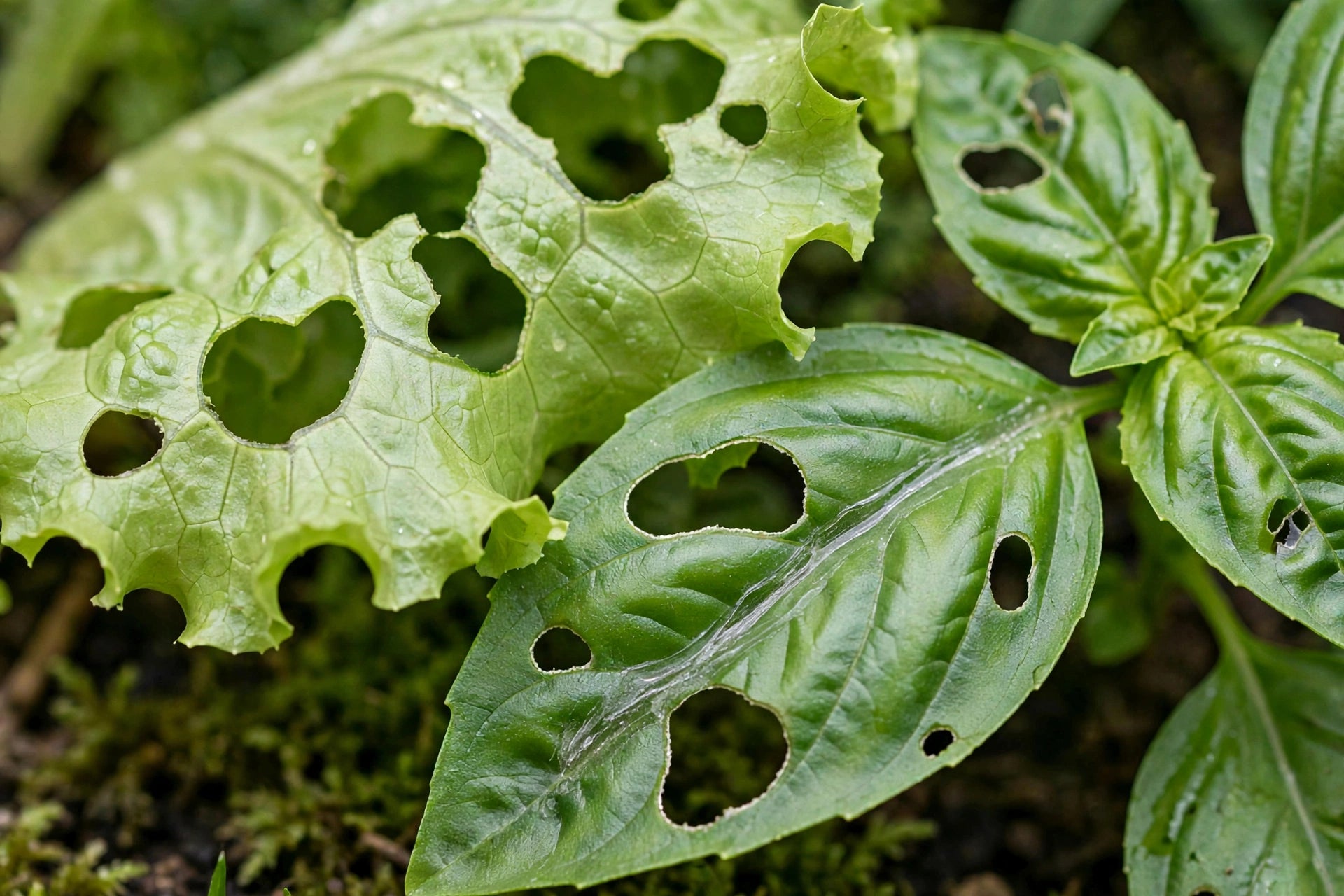
Three signs together make a confident diagnosis. One sign alone could be something else — this is where the uncertainty framing matters, because caterpillars, earwigs, and beetles all chew holes too.
1. Irregular holes with smooth edges. Slug and snail feeding leaves ragged-edged, uneven holes that are often smooth along the bite line, with no insect droppings (frass) nearby. Holes typically start on the lower leaves and work upward, and seedlings may be eaten down to the stem overnight. Compare with our guide on irregular holes in leaves to separate slug feeding from caterpillar and beetle chew patterns.
2. Silvery slime trails. Dried mucus glints on soil, leaves, and paths — the signature almost no other garden pest produces. Fresh trails are wet and glossy; old ones dry to a silvery sheen you can see from several feet away in morning light. Our guide to slime trails in the garden shows how to tell fresh, active trails from old dried ones.
3. Overnight seedling losses. Transplants that looked fine at dusk and are gone by dawn, often with the stem cleanly severed at soil level. Cutworms do this too, which is why the slime-trail check is the tiebreaker: no trails, suspect cutworms; trails present, suspect slugs or snails.
If you see holes with frass pellets or neatly skeletonized leaves, the culprit is more likely an insect — see our guide on chewed leaf edges and what causes them, and if the leaf looks lacy rather than holed, compare with skeletonized leaves — and if whole seedlings vanish with no trails at all, read why seedlings get eaten overnight for the full differential.
Which crops take the worst slug damage
The table below is our own compilation from university extension slug-host lists: it ranks common garden crops by how heavily slugs and snails target them, so you can decide where to place your strongest defenses.
| Crop | Slug-damage risk | What they target |
|---|---|---|
| Lettuce and leafy greens | Very high | Seedlings, outer leaves, entire small plants |
| Basil | Very high | Tender leaves chewed to lace; seedlings destroyed |
| Cabbage family (broccoli, kale) | High | Lower leaves, seedlings; holes in leaf centers |
| Beans and peas | High | Seedlings eaten at the base before establishment |
| Hostas and bedding flowers | High | Leaf centers chewed out overnight |
| Tomatoes and peppers | Moderate | Low-hanging fruit and lower leaves in wet weather |
| Corn and squash (established) | Low | Mostly seedlings; tough mature foliage resists |
| Zinnias and marigolds | Moderate | Seedlings and low leaves; trap-crop potential |
The pattern is clear: tender, low-growing, moisture-loving crops suffer the most. That means your lettuce, basil, and flower seedlings deserve the board traps and barriers, while established tomatoes and peppers mostly need cleanup around their bases.
Slug season calendar: when pressure peaks
Slug pressure is not constant through the year — and no single calendar fits every garden. Timing shifts strongly by climate region, so what follows is a regional breakdown rather than a universal schedule. Find your region, note your current window, and put its highest-value action at the top of your to-do list.
| Season window | Cool-wet regions | Hot-dry regions | Humid regions |
|---|---|---|---|
| Early spring | Very high — set board traps the day transplants go in | Low, concentrated in irrigated beds — switch to morning-only watering | High — start night handpicking at first transplant |
| Late spring–early summer | Peak — run the evening census weekly; bait per label if counts cross threshold | Moderate — clear shelters and debris around every bed | Peak — traps plus morning watering, every day |
| High summer | Moderate — keep traps out through wet spells | Low — spot-check damp micro-zones near irrigation | High — keep gritty barriers on new seedlings |
| Fall | High — deep cleanup to cut overwintering egg clusters | Rising with autumn rain — refresh traps before the rains start | High — fall cleanup, then succession-sow |
Where a spring window wipes out a first sowing, do not wait a year to try again: succession-sow fast-growing greens and start lettuce seeds and basil seeds indoors, then set out stocky transplants that can survive a little nibbling while your traps do their work. Fall is the other high-value window most gardeners skip: the eggs laid now hatch into next spring's population, so one thorough cleanup in autumn buys you a quieter spring.
The honest uncertainty: a single wet week can pull pressure forward by a fortnight, and a dry spell can pause it entirely. Use the calendar as a starting guess, then let your own evening counts — see the census below — override it.
Your IPM control plan, in order
Integrated pest management is not a menu to pick from — it is an order. Prevention and cultural controls come first because they cost nothing and keep working every night; physical controls come next; biological allies third; and least-toxic chemical options only when everything above has not been enough. No single method is a silver bullet, and none of them work if you skip the first step.
1. Prevention and cultural controls
Water in the morning, not the evening. Wet foliage and damp soil at dusk are an invitation; morning watering lets surfaces dry during the day so the garden is less hospitable when slugs come out. This one change often cuts damage more than any gadget.
Remove daytime shelters. Pick up boards, empty pots, fallen leaves, and dense ground litter near vulnerable beds. Thin out low foliage touching the soil. Slugs that cannot hide within a few feet of dinner stop commuting.
Space and elevate. Raised beds dry out faster at the surface than in-ground beds, and wider plant spacing improves air flow. Copper tape and copper mesh collars around pots or bed rims are reported to deter crossing by extension sources — treat them as a supplement to cleanup, not a replacement for it.
Start the most vulnerable crops indoors. Basil is one of the hardest-hit crops on the risk table above. Starting your basil from seed indoors and transplanting stocky, established plants gives slugs a much tougher target than a fragile seedling bed. The same holds for lettuce: succession-sow lettuce seeds indoors and set out plants that can survive a little nibbling, rather than direct-sowing into slug territory during a wet spring.
2. Mechanical and physical controls
Night handpicking with a flashlight. Go out an hour or two after dark, especially after watering or rain, and collect slugs and snails into a bucket of soapy water. Ten minutes a night for a week can visibly drop a local population, because you are removing breeding adults before they lay eggs.
Board and shelter traps. Lay damp boards, newspaper, or overturned pots near vulnerable beds and check under them each morning. The slugs that gathered overnight are easy to collect — a simple census that also removes them.
Beer traps. Bury a jar or cup rim-high with a few inches of beer in the bottom; slugs are attracted, fall in, and drown. They work well as a monitoring tool and can catch impressive numbers, but keep them a few feet away from the plants you are protecting — a trap right in the bed can lure more slugs in than it catches. For the full build, see our step-by-step beer-trap build. Trap placement matters as much as the trap itself; our general gardening tools guide covers the monitoring mindset that makes traps pay off.
Barriers for seedlings. Sharp-edged rings (crushed eggshells, coarse sand, diatomaceous earth) around individual seedlings can help in dry weather, though heavy rain quickly defeats them. Use them as a short-term shield for newly transplanted lettuce and flowers, not as a season-long solution. Browse sturdy flower seeds and vegetable seeds if you need backup seedlings to fill beds that took heavy losses.
3. Biological controls
Welcome the predators you already have. Ground beetles, rove beetles, firefly larvae, frogs, toads, and birds all eat slugs and snails. A mulch-free dry zone near beds, a shallow water dish for toads, and avoiding broad-spectrum sprays keep these allies on the job. Ground beetles in particular are voracious slug-egg predators — see our post on ground beetles as your slug cleanup crew.
Decollate snails. In some warm climates the predatory decollate snail feeds on common garden snails, but it is restricted or discouraged in some states (including parts of California) because it can also harm native snails — check with your local extension office before considering them.
Parasitic nematodes. The slug-parasitic nematode Phasmarhabditis hermaphrodita is applied to moist soil in cool weather and seeks out slugs below ground. Availability varies by country and region, and results depend on soil moisture, so treat it as a targeted experiment rather than a first line of defense.
4. Least-toxic chemical options (last resort)
Iron-phosphate bait. Baits containing iron phosphate are widely considered the low-toxicity option for home gardens: slugs and snails stop feeding after eating it and die within days, and the ingredient breaks down into iron and phosphate in the soil. Scatter thinly in the evening near damage (not piled up), and always read the full product label before use — even low-toxicity products have directions that matter.
What to avoid. Older metaldehyde baits are highly toxic to dogs, cats, wildlife, and children — extension sources and poison-control guidance consistently flag them, and many gardeners have moved away from them entirely. If any pest product carries a pet-safety claim, verify it with the label and your veterinarian rather than trusting marketing claims on the label alone. This is reference-only guidance, not veterinary advice.
Control methods compared
| Method | Best timing | Effort level | Trade-offs |
|---|---|---|---|
| Morning watering + cleanup | Every day, all season | Low | Free and always on, but slow to show results alone |
| Night handpicking | 1–2 hours after dark, wet evenings | Medium | Very effective, but requires you to be out there |
| Board traps | Set overnight, check each morning | Low | Easy and cheap; only catches slugs sheltering nearby |
| Beer traps | Warm wet spells | Medium | Good monitoring, must be refilled; can lure slugs inward |
| Copper barriers | Before planting out seedlings | Low | Weather-proof once installed; mixed results in trials |
| Iron-phosphate bait | Evening, when damage is active | Low | Reliable knockdown; follow the label exactly |
| Predators (beetles, toads) | Ongoing, all season | Low | Free long-term help; cannot rescue a bed tonight |
Verdict — choose morning watering plus shelter cleanup if… you want the cheapest plan that works every night without you: it removes the moisture and hiding places slugs depend on. choose night handpicking plus board traps if… you need fast results this week on a bed of lettuce or basil seedlings. choose iron-phosphate bait if… you have done the cultural and mechanical steps and damage is still ongoing — it is the last-resort option, not the first.
The 10-minute evening slug census
Here is the habit that changed how I run slug control: a ten-minute evening count, three nights in a row, before deciding anything. One bad morning is not data — a three-night average is. This is a first-hand walkthrough of the routine, including the thresholds I actually use to decide when a bed needs more than traps.
- Set board traps at dusk. Lay damp boards, newspaper, or overturned pots beside your most-damaged beds about an hour before dark.
- Flashlight sweep two hours after dark. Walk each bed slowly and check the undersides of lower leaves, the soil surface, and the traps themselves.
- Count and record by bed. Write down the number per bed in a notebook or phone note — memory lies, written counts do not.
- Check the slime trails. Fresh glossy trails mean feeding happened tonight; old dry trails are history. Count only fresh activity.
- Repeat for three nights. One night is a snapshot; three nights smooth out the weather swings that make counts jump around.
- Act on the threshold. Average your three nightly counts per bed and use the table below.
| Average nightly count per bed | What to do |
|---|---|
| 0–5 slugs | Monitor — keep morning watering and board traps in place |
| 6–20 slugs | Step up: add more traps, remove daytime shelters, hold morning-only watering |
| 20+ slugs | Add iron-phosphate bait per the label — only after the cultural steps above |
Uncertainty framing matters here: counts vary night to night with weather, so a single rainy night can double your number and a dry night can halve it. That is exactly why the rule is three nights, not one — act on the average, and re-run the census after any change you make so you can see whether it worked. For an early-warning target at the bed edge, plant a sacrificial row of zinnia seeds: slugs hit the trap crop first, and a chewed row of zinnias tells you pressure is rising before your lettuce takes the hit.
A note on climate and region
Slug and snail pressure varies strongly by climate region. Gardens in the Pacific Northwest and other cool, wet regions deal with the heaviest pressure — long wet springs mean slugs stay active for months. In hot, dry climates, damage concentrates around irrigated beds and during rainy spells, so your controls should focus on watering schedules and the few damp micro-spots rather than the whole garden. Adjust the plan to your weather: if it has been raining for a week, expect a population surge about two weeks later as eggs hatch into the moisture.
Frequently asked questions
Are the holes in my leaves definitely from slugs?
Not necessarily — holes with slime trails are very likely slug or snail damage, but holes without trails could be earwigs, caterpillars, or beetles. This looks most like slugs or snails when the holes have smooth edges, seedlings disappear overnight, and you can find silvery trails in the morning. When in doubt, do the flashlight check after dark: catching the feeder in the act ends the uncertainty.
Do coffee grounds or eggshells really stop slugs?
Extension trials show mixed results for kitchen-remedy barriers. A ring of coarse material can slow a slug on a dry night, but rain flattens the effect quickly, and determined slugs cross most of them. Treat these as temporary seedling shields, and put your real effort into morning watering, shelter removal, and traps.
Is it safe to use slug bait around pets and kids?
Iron-phosphate baits are generally described by extension sources as the lower-toxicity choice, but "lower toxicity" is not the same as "safe to eat" — keep children and pets out of treated areas and store all pest products locked away. Avoid metaldehyde products entirely around pets. For specific pet-safety questions, ask your veterinarian; this article is garden reference, not veterinary advice.
Will slugs come back every year?
Yes, if the habitat stays slug-friendly. Eggs overwinter in moist soil and under debris, so fall cleanup — removing boards, pots, and litter from beds — genuinely reduces next spring's population. A garden with morning watering, clean beds, and fewer shelters starts each season with far fewer slugs than one that was left messy over winter.
Should I relocate slugs instead of killing them?
Relocating slugs a short distance rarely works: they are strongly oriented to moisture and can return, and dropping them in a neighbor's or a wild area just moves the problem. Handpicking into soapy water is the standard recommendation because it actually removes breeding adults from your garden's population.
Do I need to identify the exact slug species?
For home-garden control, usually not. The common garden slugs and snails respond to the same IPM plan — cleanup, traps, handpicking, barriers, bait as a last resort. Species identification matters mainly if you are considering decollate snails or region-restricted biocontrols, in which case your local extension office can help.
Do slugs eat seeds before they sprout?
Rarely — slugs mostly target seedlings and tender growth rather than seeds buried at proper depth. This looks most like slug feeding when sprouts vanish just as they emerge; unsprouted seed sitting on wet soil surface can also be found and eaten. The practical fix is depth and timing: sow at the depth on the packet, and start vulnerable crops like basil indoors so what emerges is a seedling with a fighting chance rather than a slow-germinating target.
Can a garden ever be completely slug-free?
No — and aiming for zero is how gardeners burn out. Eggs overwinter in the soil, neighboring gardens reseed yours, and one wet week can restart pressure. The realistic goal is keeping counts below the damage threshold in the census above, not eradication. A garden that holds morning watering, clean beds, and working traps through the season simply never sees the explosion an untended garden does.
Why do I see more slugs after rain — how soon does damage show?
Moisture is the trigger: slugs feed most actively on wet nights, so fresh damage usually appears the morning after a rainy evening. This looks most like a weather-driven surge when holes and trails multiply within a day of rain — but a second, bigger wave about two weeks after a sustained wet spell is also common, as eggs laid in the moisture hatch. Expect the first, watch for the second, and re-run your evening census after any long rainy stretch.
Grow it back: replant with slug-tougher choices
If a bed of seedlings was wiped out, the fastest recovery is to replant with stockier transplants started indoors rather than direct-sowing into the same danger zone. Fill the gaps with basil seeds and lettuce seeds started inside for a second wave, protect the new transplants with board traps and night checks for the first two weeks, and keep morning watering as your standing habit. Every control in this plan compounds — none of them work in isolation, and all of them work better the earlier you start.
Sources
- University of California IPM — Slugs and Snails Pest Notes
- UC IPM Agriculture — Slugs and Snails
- Penn State Extension — Slugs as Pests of Field Crops
- Michigan State University Extension — Controlling Slugs and Snails in the Garden
- University of Wisconsin Horticulture Extension — Slugs
- University of Minnesota Extension — Slugs
- Clemson Cooperative Extension — Snails & Slugs in the Home Garden
- Cornell IPM — Slug and Snail Control
- Oregon State Extension — Identification and Management of Pest Slugs (EM 9912)