Irregular Holes in Leaves: What Caused Them & How to Read the Damage
By Paul Smith, pemdasgarden.com

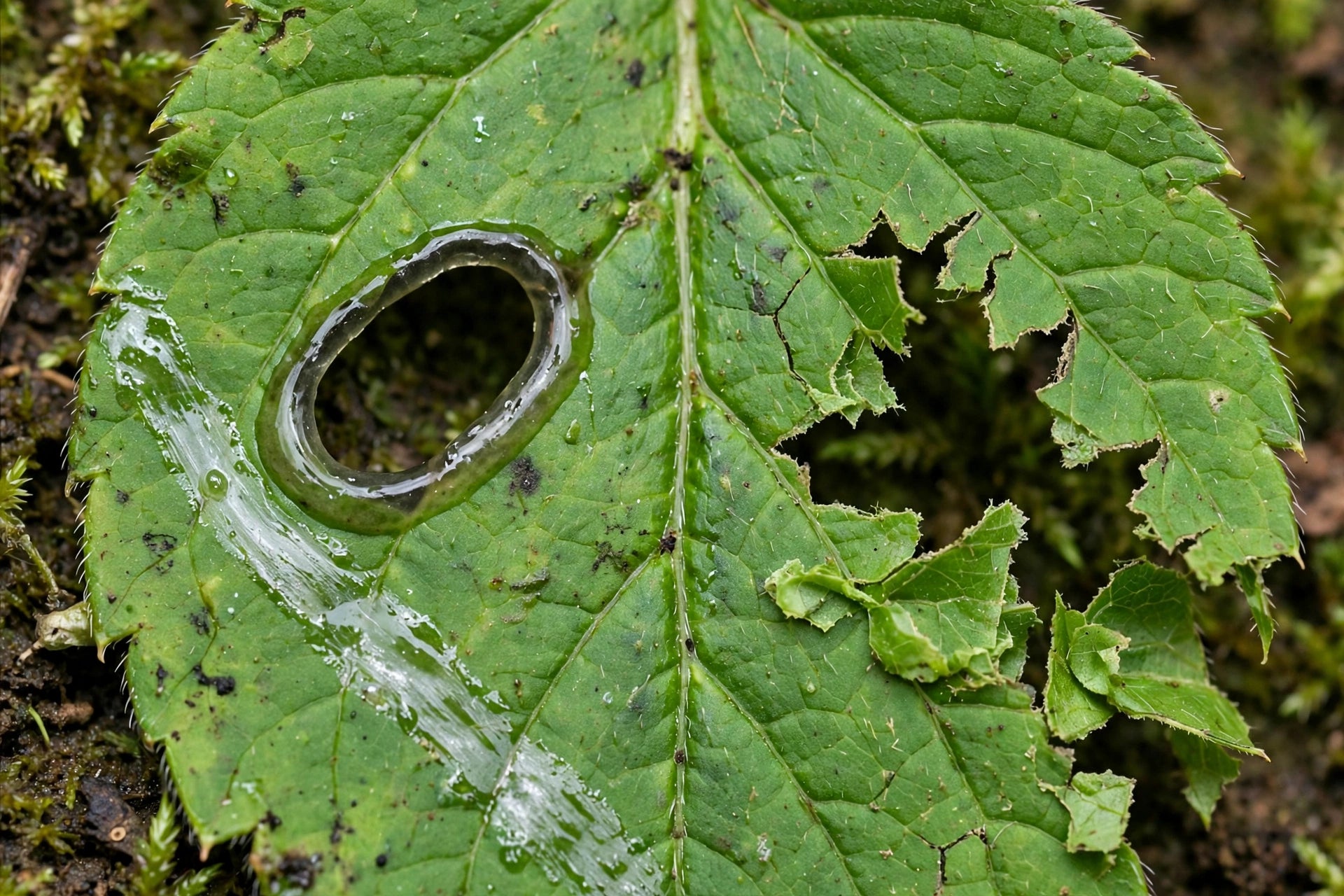
Smooth-edged, irregular holes in your leaves plus silvery slime trails on the soil or foliage: this looks most like slugs or snails — but caterpillars, earwigs, and flea beetles all chew holes too, so the edges of the damage are what tell the real story. This guide teaches you to read those edges like a diagnostic chart, confirm the culprit with a single night-time check, and respond with an IPM plan in the right order: prevention first, least-toxic chemical options last.
This is the symptom-first companion to our slugs-and-snails pillar, Slugs & Snails: Garden Damage, Identification & IPM Guide, which covers full identification and the complete control playbook. You found holes — this page helps you name the maker.
Read the edges: the damage-pattern diagnosis matrix
Different feeders leave different signatures, and the single most useful clue is the shape of the hole's edge. The table below is our own compilation from university extension pest profiles — use it as a field chart, not a verdict. Every row below is a "most likely" reading, because two culprits can and do feed on the same plant.
| Culprit | Hole and edge shape | When it feeds | Other signs | Plants hit hardest |
|---|---|---|---|---|
| Slugs & snails | Irregular holes with smooth, almost melted-looking edges; chewed from the leaf interior or margin | Night and damp, overcast days | Silvery slime trails on leaves and soil; no insect droppings; seedlings severed at the base | Lettuce, basil, hostas, seedlings of almost anything |
| Caterpillars (e.g., imported cabbageworm) | Ragged, torn edges; large uneven bites; may skeletonize brassica leaves down to the veins | Daytime, often visible on the leaf | Dark frass (droppings) pellets on leaves below the damage; green caterpillars on leaf undersides | Cabbage, broccoli, kale, and other brassicas |
| Earwigs | Jagged, irregular notches, often on petals and soft young leaves | Night | Hides by day in tight, damp spaces (rolled leaves, flower buds, under pots); no slime trails | Dahlias, zinnias, marigolds, young transplants |
| Flea beetles | Many small, round "shot-holes" like the leaf was peppered with a pin | Daytime, warm sunny weather | Tiny jumping black or striped beetles that spring away when disturbed; seedlings stunted | Eggplant, radish, turnip, brassica seedlings |
| Japanese beetles | Leaf skeletonized to a lace-like network of veins, not punched holes | Daytime, mid-summer | Metallic green-and-copper beetles feeding in groups; adults active roughly six summer weeks | Roses, grapes, linden, fruit trees |
Notice what separates the rows: slime trails mean slugs or snails (almost nothing else makes them), frass pellets mean a caterpillar, tiny round shot-holes mean flea beetles, and lace-like skeletonizing means Japanese beetles. Cornell's slug IPM fact sheet makes the same distinction the other way around: slug damage is easily confused with caterpillar injury, but caterpillars leave droppings on the leaves, while slugs leave slime. The Missouri Botanical Garden's Japanese beetle profile confirms the group's summer feeding window and their distinctive group-feeding habit.

Which culprit fits your holes?
Match what you see against this decision table, then read the verdict below it before you act.
| What you see | This looks most like | But also possible |
|---|---|---|
| Smooth-edged irregular holes + silvery trails | Slugs or snails | — |
| Ragged torn holes + dark frass pellets | Caterpillars | Slugs if trails are also present |
| Jagged notches on petals, no trails, chewed buds | Earwigs | Slugs on the leaves below |
| Tiny round shot-holes, seedlings stunted | Flea beetles | Slugs rarely — shot-holes are too small |
| Lace-like skeletonized leaves, no holes at all | Japanese beetles | Older caterpillar feeding on brassicas |
| Holes with NO trails and NO frass | Earwigs or an early caterpillar | Do the night check below to settle it |
| Clean round holes with dark or purplish halos, no trails, no frass, after wet weather | Shot-hole disease (leaf spot), not a chewer | Flea beetles or slugs — check the section below |
| Skeletonized patches hugging the veins on brassicas, green caterpillars on undersides | Imported cabbageworm | Japanese beetles |
Verdict — treat for slugs or snails if… the holes have smooth edges, damage appeared overnight, and you can find silvery trails in the morning light. Look elsewhere if… you find frass pellets (treat for caterpillars instead), see tiny jumping beetles (flea beetles), or the leaf is lacy rather than holed — compare with our guide to skeletonized leaves before you act, because slug controls will not fix a beetle problem. If your diagnosis lands on slugs-or-snails and you want to know which of the two you are hosting, our slug-vs-snail-damage comparison breaks them apart. When nothing is conclusive, the flashlight walkthrough below is the tiebreaker that ends the guessing.
Not all holes are chewed: the shot-hole disease look-alike
Some "holes" were never bitten at all. Shot-hole disease — the fungal leaf spot caused by Wilsonomyces carpophilus on stone fruits (peaches, plums, cherries, apricots), described by UC IPM — starts as small dark spots with purplish halos; the dead centers then drop out, leaving clean, almost perfectly round holes rimmed with a dark margin. Bacterial leaf spot can produce the same dropped-out look on other plants. There is no frass, no slime trail, and no jagged tearing — and the damage typically follows a stretch of wet weather. Chewed holes, by contrast, have torn, rasped, or melted edges, and the culprit usually leaves a calling card: slime, frass, or the feeder itself.
This looks most like chewing if the edges are ragged or you find trails or droppings — but a leaf-spot disease that drops out its centers is also possible when the holes are uniform circles with dark halos, nothing was caught feeding at night, and rain or overhead watering came first. It is easy to misread disease holes as chewing damage, and the mistake is expensive: slug baits and hand-picking do nothing for a leaf spot, while a disease response (sanitation, airflow, dry foliage) does nothing for slugs. So before you buy or set a single control, check the halo test: uniform round hole + dark rim + no feeding signs = suspect disease first, and prune out spotted leaves into the trash rather than the compost to cut the source of new infections.
Where the hole sits on the leaf: margin vs interior vs veins
Before you name the feeder, look at where on the leaf the damage sits — position is an independent clue from edge shape, and combining the two narrows the field fast. This table is our own compilation from the extension profiles cited below; treat every row as a "looks most like" reading, because mixed feeding happens.
| Where the damage sits | This looks most like | Why |
|---|---|---|
| Margins only — jagged notches cut into leaf edges and petals | Earwigs | Earwigs feed from the outside in, chewing irregular notches on soft young leaves and petals; no slime, no frass |
| Interior — smooth, melted-looking holes away from the margin | Slugs or snails | Slugs rasp the soft interior tissue and leave silvery trails; confirm with the morning trail check |
| Tiny round holes scattered across the whole leaf surface | Flea beetles | Flea beetles pepper the entire leaf with shot-holes in hot, dry, sunny weather; look for jumping beetles when disturbed |
| Between the veins — lace left where the vein network remains | Japanese beetles | Japanese beetles skeletonize from between the veins outward, leaving the veins intact |
| Vein-hugging skeletonized patches, on brassicas only | Imported cabbageworm | Cabbageworms chew ragged holes and skeletonize brassica leaves down to the veins; check undersides for green caterpillars and frass |
| Uniform round holes with a dark or purplish halo | Shot-hole disease, not a chewer | Disease spots drop out clean circles with haloed rims — no frass, no trails; follows wet weather |
Use position with the edge matrix above: margin notches with jagged edges point firmly at earwigs, while interior smooth holes plus a slime trail point firmly at slugs. This looks most like the table's answer when position and edge shape agree — but when they disagree (ragged edges in the leaf interior, for example), trust the walkthroughs below over either table, because two feeders can and do share one plant.
The 5-minute daylight diagnosis walkthrough
Run this check in daylight before your night patrol — it takes five minutes and often settles the question before dark:
1. Photograph the hole edge close-up. Get your phone within a few inches of the worst hole. A crisp edge photo lets you compare smooth-melted (slug), ragged-torn (caterpillar), or uniform-circle-with-halo (shot-hole disease) against the tables above without relying on memory.
2. Flip the leaves and check the undersides. Look for green caterpillars, dark frass pellets, and egg clusters on the undersides of damaged leaves. Frass means a caterpillar is the current feeder; no frass pushes the list toward slugs, earwigs, or disease.
3. Check the soil in morning light. Scan the soil and lower leaves for silvery trails while the dew is still on them — trails vanish as the sun dries the bed. Our guide to reading slime trails shows what fresh versus old trails look like.
4. Scan the neighboring plants. Are the holes on one plant or across the bed? Flea beetles pepper many plants at once in hot weather; slugs work outward from damp shelter; shot-hole disease follows the wettest, most crowded foliage. The pattern across plants is a clue a single leaf cannot give.
5. Check the weather and the calendar. Wet nights and rainy weeks favor slugs and disease; hot, dry, sunny spells favor flea beetles; mid-summer group feeding on roses and fruit trees points at Japanese beetles.
This walkthrough looks most like a complete diagnosis when three or more steps agree — but weather and mixed feeding can still fool it, so treat the result as your best working answer, not a verdict, and confirm with the night check below.
What to check tonight: the flashlight walkthrough
Most hole-makers on the list are nocturnal, so one well-timed night inspection beats a week of guessing. Here is how to do it:
1. Water in the late afternoon. A damp garden draws slugs and snails out after dark — Oregon State University's slug program specifically recommends watering in the late afternoon, then searching with a flashlight after dark. This single step dramatically raises your odds of catching the feeder in the act.
2. Go out 1–2 hours after full dark. Bring a flashlight and look at the base of the most damaged plants first. Slugs and earwigs will be feeding openly; caterpillars may be on leaf undersides.
3. Check the daytime shelters. Lift boards, flip over pots, look under mulch and dense low foliage, and peer into the rims of containers. Slugs cluster in these damp refuges by day, and earwigs wedge into the tightest ones. Finding the sleeper is as good as catching the feeder.
4. Run the slime-trail test in the morning. Before the sun dries everything, look for silvery trails on soil, leaves, and paths near the damage. Fresh trails are wet and glossy; dried ones glint silver. Trails present = slugs or snails, and the uncertainty ends there. No trails = shift your suspicion to caterpillars or earwigs.
5. Look for eggs while you are down there. Slugs lay clusters of small, translucent, pearl-like eggs in moist soil and under debris — destroying them now cuts next season's population. This is a detail Cornell's and UC IPM's slug profiles both emphasize for long-term control.
Your IPM-first response plan
Respond in this order — prevention and cultural fixes first, mechanical next, biological allies after that, and least-toxic chemical options only as a last resort. No single step in this plan works well alone; they compound.
1. Prevention and cultural controls
Water in the morning, at the base. Morning watering lets leaf and soil surfaces dry before slugs become active at night — the Royal Horticultural Society notes that evening watering creates exactly the wet film slugs travel on, and switching to morning watering can protect as well as some pellet treatments. Drip lines keep foliage dry altogether.
Remove daytime shelter. Pull mulch back from vulnerable plants, clear boards, bricks, and debris from beds, and raise pots on feet. Oregon State's fall slug guidance starts every control program with this cleanup step, because every shelter you remove is a daytime refuge gone.
Space and barrier tactics. Wider spacing improves air flow and dries the soil surface faster. Copper tape or copper mesh collars around pots and bed rims are reported by extension sources to deter slug crossing — treat them as a supplement to cleanup, not a replacement. A ring of diatomaceous earth around seedlings can slow soft-bodied feeders on dry nights but needs reapplying after rain or watering.
2. Mechanical controls
Hand-pick at night. With the flashlight, pick slugs and earwigs directly off plants into a bucket of soapy water. Cornell's slug IPM fact sheet lists handpicking as a core mechanical control, and it is the fastest way to remove breeding adults.
Set traps. Lay boards or damp newspaper flat on the soil near damaged plants; slugs shelter under them by day, and you collect them each morning. For beer traps — a container sunk rim-level and baited with beer or a yeast-sugar-water mix, which our guide to building a beer trap for slugs covers in full — the yeast is the attractant, so refill after rain.
3. Biological controls
Invite the predators. Ground beetles, birds, frogs, and toads all eat slugs — the RHS lists them among the key garden allies to encourage, and Oregon State's slug guidance names frogs and ground beetles specifically. Log piles, small ponds, and undisturbed corners give these predators somewhere to live; broad-spectrum insecticides kill ground beetles, so skipping sprays protects your free workforce.
4. Least-toxic chemical options — last resort only
Iron-phosphate-based baits are the lower-toxicity bait choice described by extension sources, but "lower toxicity" is not "harmless" — scatter sparingly per the label, keep children and pets out of treated areas, and store all pest products locked away. Avoid metaldehyde-based products entirely around pets and wildlife. Baits will not make your garden slug-free on their own; they are a supplement to the plan above, not a replacement for it. For pet-safety questions, ask your veterinarian — this article is garden reference, not veterinary advice.
5 mistakes that turn small holes into big losses
Hole damage is usually survivable — these are the mistakes that make it fatal or expensive:
| Mistake | Why it hurts | Fix |
|---|---|---|
| Watering in the evening | Wet leaf and soil surfaces through the night are exactly the film slugs travel on | Water in the morning at the base so surfaces dry before dark — the RHS notes this can protect as well as some pellet treatments |
| Spraying a broad-spectrum insecticide at the first holes | It kills the ground beetles and other predators that eat slugs for free — and does nothing for earwigs hiding in buds or for disease | Skip the spray and protect your ground beetles instead; diagnose first, then treat the actual culprit |
| Setting slug bait when the edges are ragged or the holes have halos | Baits only work on slugs and snails — ragged edges mean caterpillars and haloed round holes mean shot-hole disease, so the bait treats the wrong culprit | Match the treatment to the diagnosis tables above before spending a dollar on controls |
| Piling mulch against stems | Thick mulch touching stems is daytime slug shelter pressed right against the plant | Pull mulch back a few inches from stems and vulnerable seedlings; keep the crown zone clear and dry |
| Nursing chewed mature plants while new seedlings go in unprotected | Mature plants outgrow hole damage, but a seedling loses everything to one night of feeding — the unprotected replant is the real loss | Protect the replant, not the patient: ring new sowings with board traps from night one, and start fresh with lettuce seeds or basil seeds sown in succession so one bad night never ends the bed |
Replant and protect: seed choices for hole-prone beds
Once you know the culprit, the fastest recovery is replanting with healthy stock and protecting the new plants from day one. Match your replant to the bed's risk:
Basil beds. Basil is one of slugs' favorite targets — tender leaves chewed to lace overnight. Start a fresh wave of basil seeds indoors and transplant sturdy seedlings out once they have several true leaves; stockier transplants survive nibbling that would kill a sprout, and the RHS recommends transplanting sturdy plantlets rather than vulnerable seedlings for exactly this reason.
Lettuce and salad greens. Slugs are most drawn to lettuce and the cabbage family, per Oregon State's spring pest guidance. Sow lettuce seeds in succession every two weeks so one damaged planting never ends your harvest, and ring the bed with your board traps for the first month.
Tomatoes and peppers. Young tomato and pepper transplants get their lower leaves rasped by slugs and their seedlings clipped at the base. If a bed was wiped out, restart with tomato seeds and pepper seeds started indoors, harden the seedlings off well, and mulch only after the stems are woody at the base — slugs struggle with tougher stem tissue.
Flowers. For beds where earwigs are the likely culprit, remember they favor soft petals: dahlias and zinnias take the hits. Replant the gaps with flower seeds and trap earwigs with rolled damp newspaper tucked among the stems — they crowd into the tightest damp spaces by day, which makes the traps easy to empty each morning.
The rest of the vegetable patch. For general replanting after a heavy slug season, browse our vegetable collection and favor fast, vigorous growers for the recovery bed — plants that size up quickly simply outrun minor feeding damage, which is the cheapest control of all.
Frequently asked questions
I found holes but no slime trails — is it still slugs?
Maybe, but it is less likely. Slime trails are the signature almost nothing else makes, so holes without trails push caterpillars and earwigs up the suspect list. This looks most like slugs if the holes have smooth edges and damage appeared overnight — but without trails, do the flashlight check before you commit to slug controls, because caterpillars leave frass and earwigs hide in tight damp spaces, and both leave no trails.
Why do the holes appear overnight?
Because the most common hole-makers — slugs, snails, and earwigs — feed after dark and shelter by day. Damage that was invisible at dusk and obvious at dawn is the classic nocturnal-feeder pattern. This looks most like slugs or snails if the edges are smooth, but earwigs produce the same overnight timing with jagged edges and no slime trails, so read the edges before you decide.
Can these pests damage more than leaves?
Yes. Slugs and snails also chew seedlings off at the base — see why seedlings get eaten overnight for the full differential on that symptom — rasp soft fruit like strawberries, and damage flower buds. Earwigs go after petals and soft new growth. If you see chewed buds alongside holed leaves, that combination points more toward earwigs or slugs than toward the daytime beetles on the matrix.
Will a plant with chewed leaves recover?
Usually, if the growing points and most of the leaf area survive. Established plants tolerate moderate hole damage well — the real danger is to seedlings, which can be eaten entirely. This is why the replant advice above favors sturdy transplants: a plant with several true leaves can lose a few to feeding and keep growing, while a sprout cannot.
What is the difference between slug holes and caterpillar holes?
Slug and snail holes have smooth, almost melted edges and come with slime trails; caterpillar holes have ragged, torn edges and come with dark frass pellets on the leaves below. Cornell's slug IPM fact sheet uses exactly this distinction: caterpillar droppings on leaves point to caterpillars, slime trails point to slugs. When you see both trails and frass, you most likely have both feeders.
Should I water in the morning or evening if slugs are the problem?
Morning. Evening watering leaves surfaces wet through the night, which is when slugs are most active — the RHS notes that switching from evening to morning watering can protect plants as effectively as some pellet treatments. Water at the base of plants so foliage stays dry, and give the soil surface time to dry before dark.
Can a leaf disease cause holes that look like chewing?
Yes — shot-hole disease drops clean, round holes with dark or purplish halos out of spotted leaves, and it fools plenty of gardeners into buying slug bait. This looks most like chewing when the edges are torn or you find frass or trails — but uniform circles with halos, no feeding signs, and a wet spell beforehand point to disease instead. See the shot-hole section above before you treat.
Should I cut off leaves with holes?
Usually not. A leaf with a few holes still photosynthesizes, and removing it costs the plant more than the damage did — cut only if more than half the leaf is gone or the leaf is clearly dying. The exception is suspected shot-hole disease: there, sanitation matters, so remove spotted or haloed leaves and dispose of them in the trash rather than the compost to cut the source of new infections.
Do holes in seed leaves (cotyledons) matter more?
Yes — a seedling's first leaves are its entire food factory, so one night of feeding can end it while a mature plant shrugs off the same damage. This is why the replant advice above favors sturdy transplants and succession sowing: start a fresh round of lettuce seeds or basil seeds and protect the new seedlings with board traps from night one, instead of trying to rescue cotyledons that are already gone.
Sources
- University of California IPM — Slugs and Snails Pest Notes
- Cornell IPM — Slug and Snail Control Fact Sheet
- Royal Horticultural Society — Slugs and Snails Advice
- Oregon State University — Slugs & Snails, Solve Pest Problems
- University of Minnesota Extension — Slugs
- Missouri Botanical Garden — Japanese Beetle
- UC IPM — Shot Hole Disease (stone fruit)
- University of Minnesota Extension — Flea Beetles
- University of Minnesota Extension — Earwigs