Slugs on Lettuce Seedlings: Night Checks & IPM Protection
By Paul Smith, pemdasgarden.com
A row of lettuce seedlings that looked fine yesterday can be stubs by morning — cotyledons rasped away, first true leaves punched with smooth-edged holes, sometimes whole seedlings missing entirely, leaving nothing but a sliver of stem. This looks most like slug feeding, but cutworms and earwigs are also possible, so treat the reading as provisional and check at night with a flashlight before you act. Lettuce seedlings sit exactly where slugs hunt: at soil level, in constantly damp nursery mix or direct-sown rows, with tissue soft enough to eat whole. This guide explains why the seedling stage is the danger window, how to read the damage on lettuce specifically, and how to run an IPM-first protection plan while the plants are small.
This is the lettuce-seedling companion to our slugs-and-snails pillar, Slugs & Snails: Garden Damage, Identification & IPM Guide, which covers full identification and the complete control playbook. If you found holes and have not tied them to a plant yet, start with Irregular Holes in Leaves: What Caused Them & How to Read the Damage; if you found the silvery trails themselves, see Slug Slime Trails: Read Them & Find the Culprit Tonight. Our basil companion post, Slugs on Basil: Damage Signs, Night Checks & IPM Rescue, covers slug pressure on mature herb foliage — a different stage, a different plan.
Why lettuce seedlings are slug magnets
University of Minnesota Extension notes that slugs feed on many plants but hit seedlings hardest, and University of Maryland Extension lists lettuce among the soft-leaved leafy crops slugs target. The reasons stack up against the seedling. Cotyledons and first true leaves hold almost no water and no toughness, so a slug can eat an entire plant in one feeding bout rather than taking a hole and moving on. Nursery trays and direct-sown rows are kept constantly damp — exactly the soil surface slugs patrol at night — and seedlings go out during the cool, wet shoulder seasons when slugs are most active. Utah State Extension's leafy-greens guide confirms the pattern: slugs and snails chew holes through seedling leaves and can consume whole young plants.
Hardening off adds a second danger window. Trays moved outside to toughen up sit overnight in unfamiliar soil-level humidity, often on the ground where slugs live, with no established root system to fuel regrowth. If you are hardening off now, the protection plan below matters as much outdoors as in the nursery.
Lettuce seedling slug damage: what it actually looks like
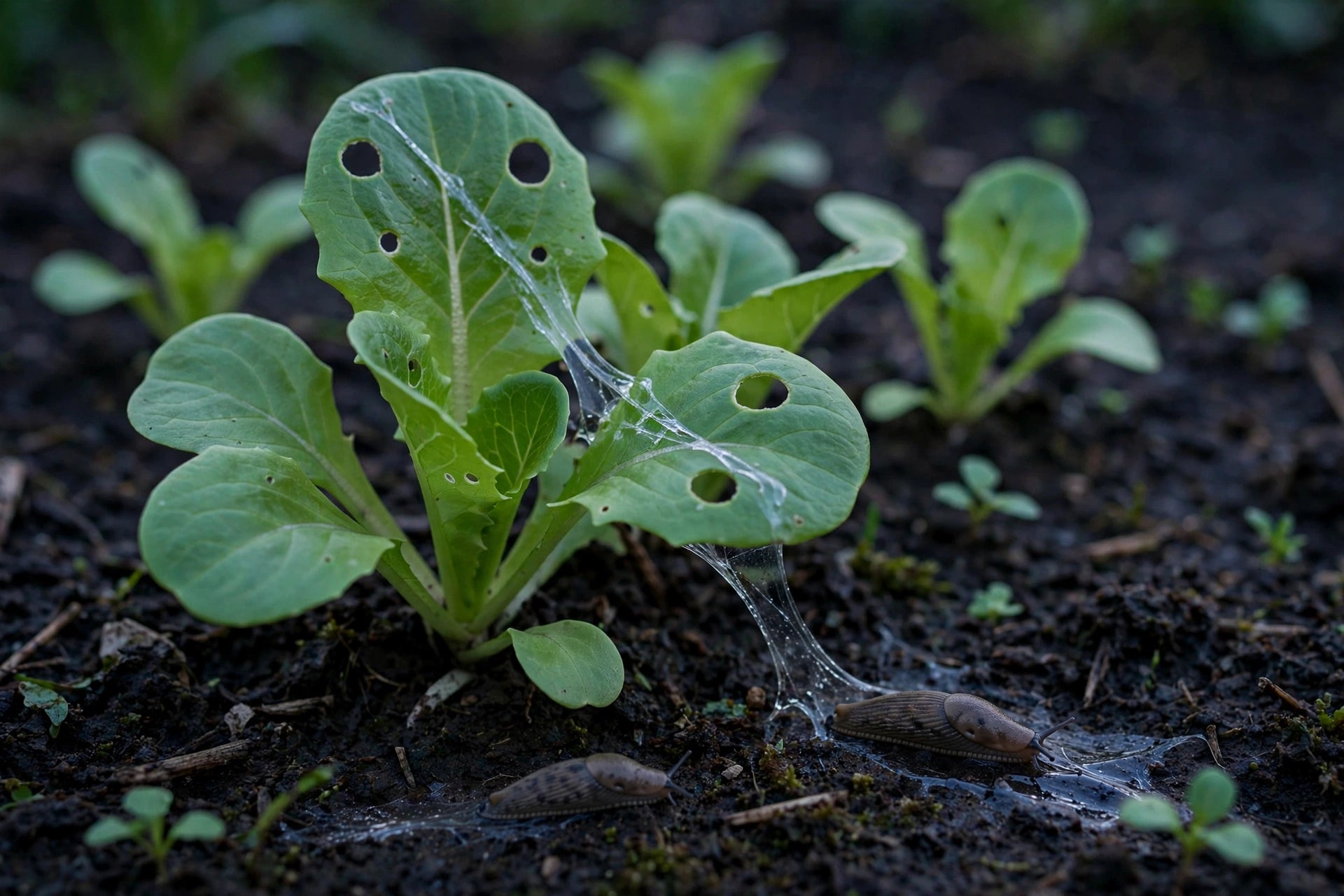
Slug feeding on lettuce seedlings leaves round, smooth-edged holes rasped cleanly through the thin leaf — the edges look polished, not ragged. On cotyledons the damage is often total: both seed leaves eaten to the petiole, or the seedling gone entirely with only a wet stub left. On seedlings with true leaves, slugs rasp the softest tissue first, so the inner heart leaves and the growing tip take the worst of it; silvery, dried slime trails on the tray edge, the soil surface, or the remaining leaf are the confirming sign.
Direct-sown rows tell the same story at a larger scale. UC IPM's slug pest notes warn that slugs can destroy seedlings outright, and a lettuce row can read as patchy germination when it is actually patchy predation — evenly sown rows with random gaps, where the missing plants were eaten between emergence and first thinning. The five-minute night check below is how you tell the difference between slugs and a sowing problem.
Transplants get a milder version of the same treatment. A lettuce transplant that went out with four true leaves may lose the two lowest to rasping while the rest survives; the plant usually outgrows it, but the chewed leaves rot in damp weather and the wound invites decay, so prompt cleanup of the damaged foliage helps.
Slug damage vs the look-alikes: the comparison table
Lettuce seedlings have three common impostors, and each calls for a different response. Cutworms sever stems at the soil line; earwigs chew ragged margins at night; and damping-off — a soil-borne disease, not a pest at all — collapses seedlings that were never eaten. Use the table, then confirm at night.
| What you see on the lettuce seedling | Slug | Cutworm | Earwig | Damping-off (disease) |
|---|---|---|---|---|
| Plant symptom | Smooth, cleanly rasped holes in leaves; cotyledons eaten to the stem; seedling sometimes gone entirely | Stem severed cleanly at or just below the soil line; the toppled top lies intact beside the stub | Ragged, torn leaf margins and irregular chewing; seedlings chewed but rarely erased | Stem pinched thin and brown at the soil line; seedling topples and collapses, nothing eaten |
| When it happens | Night; hides by day under trays, boards, mulch | Night; curls in the soil by day | Night; hides by day in tight, damp crevices | Any time — a disease spreading in cool, wet soil |
| Signature extra sign | Silvery dried slime trails on leaves, tray edges, soil | Cut stem with no slime; the severed top often untouched | Dark pellet-like droppings; no slime | No insect, no slime — just a pinched, water-soaked stem base |
| Direct-sown rows | Random gaps; missing seedlings with slime on the row | Seedlings toppled in a line along the row | Patchy chewing across many seedlings | Seedlings emerge, then flop over in patches |
| Night flashlight check | Soft-bodied, shell-less, gliding on slime | Fat C-shaped caterpillar curled in the soil near the stem | Fast, dark, with pincer-like cerci on the rear | No animal at all |
The verdict: call it slugs if the holes have smooth, rasped edges and you find silvery slime trails on the soil, tray edges, or remaining leaves — that pair is the extension-standard confirmation. Call it cutworms if seedlings are severed at the soil line with the intact top lying beside the stub and no slime anywhere. Call it earwigs if the edges are ragged and torn with no slime. Suspect damping-off, not a pest at all, if stems pinch and brown at the soil line with no feeding on the leaves. When the signs are mixed, or damage continues with no trails found, run the night check below instead of guessing — one evening of observation beats a week of treating the wrong problem.
Lettuce seedling vulnerability by growth stage
No other stage of the plant's life is as exposed as this one. The table below — compiled from extension slug profiles — maps how slug pressure changes from sowing to establishment, so you can concentrate protection on the weeks that actually decide the crop.
| Growth stage | What slugs target | Moisture factor | Slug risk | Watch for |
|---|---|---|---|---|
| Nursery tray, pre-emergence | Swollen seeds and seed coats at the surface | Surface kept constantly wet for sprouting | Moderate | Seedlings that never emerge; seed coats dragged into the soil |
| Cotyledon stage | The whole seedling, a centimeter tall | Mist and daily watering; trays on damp ground | Severe | Cotyledons rasped to the stem; seedlings gone by morning |
| First true leaves | Soft inner leaves and the growing tip | Frequent watering to keep young roots moist | Severe | Heart leaves shredded; growing tip destroyed |
| Hardening off outdoors | Tender tray seedlings overnight on the ground | Outdoor humidity; trays sitting on damp soil | Severe | Trays fine indoors, chewed the first nights outside |
| Fresh transplant (4–8 true leaves) | Lowest leaves resting near the soil | Daily establishment watering | High | Lower leaves rasped; chewed foliage rotting in damp weather |
| Established young plant | Outer wrapper leaves | Soil surface drying between waterings | Moderate | Holes in outer leaves; heart usually safe |
The pattern is unforgiving: soft tissue plus damp soil equals maximum pressure, and lettuce seedlings combine both until the true leaves toughen. Guard the cotyledon-to-first-true-leaf window and the hardening-off nights most aggressively — once the plant has eight true leaves and the soil surface dries between waterings, the worst of the danger is past.
The five-minute seedling night check
Slugs feed after dark, so the most reliable diagnosis takes five minutes and a flashlight. Wait until at least an hour after full dark, then work the tray or row methodically:
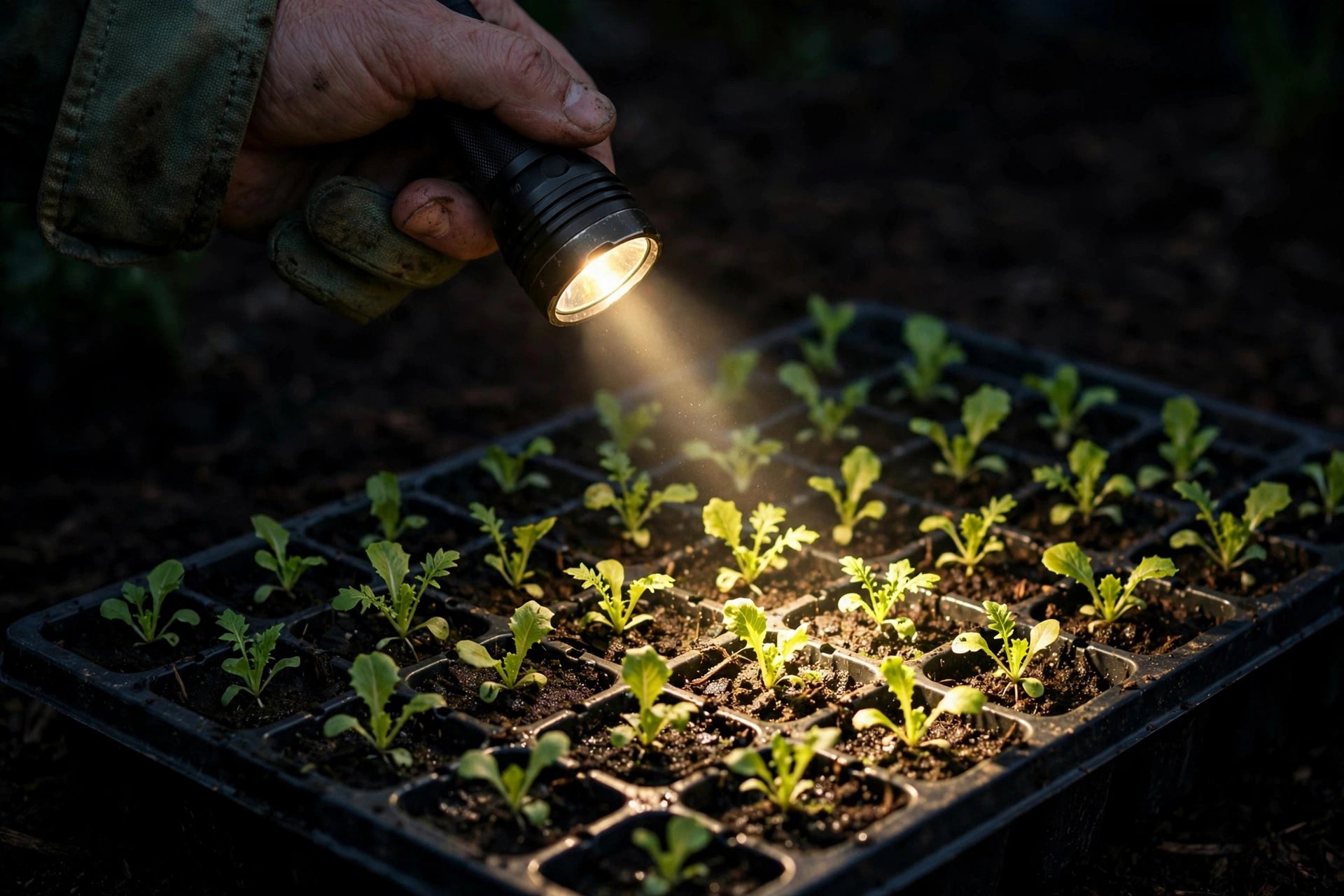
- Shine the beam low across the soil or tray surface — slugs gliding on damp soil catch the light and are unmistakable.
- Lift the tray and check its underside and rim, plus the ground it sat on; hardening-off trays hide feeding slugs beneath.
- In direct-sown rows, part the row gently and check the soil line of the damaged seedlings for feeding slugs and fresh, wet slime.
- Check the daytime shelters nearby: boards, overturned pots, mulch clumps, and the shady side of the bed edge.
- If you find slugs, handpick them into soapy water on the spot; it is diagnosis and first treatment in one trip. Cutworms, if you find them instead, are fat and curled in the soil near the severed stem.
One slug-free night does not clear them — slugs may simply be sheltering deeper during a dry spell — but two or three quiet nights with no fresh damage means the pressure has likely passed and the seedlings can be left to grow.
Your lettuce seedling IPM plan, in order
Work the IPM sequence from least to most intervention. Seedlings are the most fragile stage, so every step below is weighted toward keeping small plants untouched.
Prevention first. Water in the morning so the tray or row surface dries by nightfall, when slugs become active — Ohio State Extension lists reducing excess moisture as a core slug strategy. Raise nursery trays off the ground on benches or wire mesh so slugs cannot climb in from the soil, and keep the area under benches clear of debris. If you are starting over after a total loss, sow fresh lettuce seed indoors into clean mix rather than replanting into a bed where slugs already hold territory.
Cultural controls. Clear the daytime shelters around trays and rows: boards, dense mulch piled against young stems, overturned pots, and weed clumps at the bed edge. Space direct-sown rows for airflow so the soil surface dries between waterings, and pull mulch back several inches from the seedling line. Harden off on a dry, raised surface — a bench or pallet — instead of setting trays directly on damp ground; the hardening-off row in the vulnerability table above exists because ground contact is the single biggest risk of that stage.
Mechanical controls. Cover nursery trays and direct-sown rows with fine mesh or row cover the evening you sow, and leave it on until the plants have several true leaves — physical exclusion works while seedlings are too small to fight back. Wrap copper tape around the rims of trays and raised beds; Utah State Extension lists copper sheeting as an effective slug barrier, though results vary and it works best as one layer of defense rather than the only one. Run the night check as control: handpick feeding slugs into soapy water, and set board traps — a damp board laid near the row, collected each morning. Our gardening tools guide covers the physical barriers and row-cover setups worth having on hand.
Biological controls. Ground beetles, frogs, toads, and birds all eat slugs, so skip broad-spectrum insecticides that kill these allies, and leave a small undisturbed corner — a log pile or stone stack — as beetle habitat near the bed. A strip of flowers from our flower seed collection near the vegetable bed feeds the adult stages of predatory beetles and other beneficial insects; browse the vegetable collection to plan the bed so one pest never takes the whole planting. Biological help is slow but free, and it works while you sleep, exactly when slugs do.
Least-toxic chemical, last. If pressure is heavy on transplants and the steps above are not keeping up, iron phosphate bait is the option extension sources discuss for use around edibles — but read this as reference information, not a recommendation, and no brand is endorsed here: follow the label exactly, scatter at label rates without piling pellets against stems, keep pellets off the leaves, and wash harvested lettuce thoroughly. It is described as lower-risk around pets and wildlife than older metaldehyde baits, but it is still a pesticide — keep pets from eating the bait directly, and if you have any doubt, ask your local extension office (or your veterinarian for pet questions) before using it near food plants. No bait promises a slug-free garden on its own; it is one tool in the sequence, not the sequence. On seedling trays themselves, covers and handpicking are the safer first answer.
Seedling protection methods compared
Not every method fits every seedling setup. The table compares the realistic options for the seedling stage; the verdict below it tells you which to reach for first.
| Method | Effort | Seedling-stage fit | Best for |
|---|---|---|---|
| Night handpicking | Low — about 10 minutes after dark | Excellent — doubles as diagnosis | Small trays and short rows; confirms the culprit while controlling it |
| Row cover or fine mesh over trays | One-time setup; remove for watering, replace after | Excellent — total physical exclusion | Nursery trays and direct-sown rows from sowing to several true leaves |
| Copper tape on trays and raised beds | One-time setup | Good — one more layer of defense | Nursery trays and container sowings on benches |
| Board or cardboard traps | Low — set once, check each morning | Good | Finding where slugs hide by day around the bed |
| Beer traps | Moderate — sink cups, refill weekly | Fair — cups near, not among, tiny seedlings | Heavy pressure across a whole direct-sown bed |
| Raised benches for trays | One-time | Excellent | Hardening-off stage — breaks the ground-contact path slugs use |
| Iron phosphate bait | Low — scatter at label rate | Last resort — transplants, not tray seedlings | Widespread pressure on transplants when physical methods lag behind |
| Restart indoors from seed | Low | Best when the crop is already lost | Total losses and severed growing tips — faster than nursing stubs |
The verdict: choose row cover over the tray or row plus night handpicking if you are starting seedlings now — it is the only combination that both excludes and confirms, and nothing is applied to plants you will eat. Choose raised benches and copper-taped tray rims if you are hardening off, the stage the vulnerability table flags as severe. Choose beer traps and board traps when a whole direct-sown bed is under pressure and handpicking cannot keep up. Reach for iron phosphate only on transplants after the physical methods have had a fair trial — and if you do, follow the label to the letter, keep pellets off the foliage, and wash every harvest. For a tray chewed to bare stems with the growing tips destroyed, skip the rescue and restart: a fresh sowing of lettuce seed outruns a struggling stub almost every time.
When to restart from seed
Sometimes the honest answer is a new sowing. Restart from seed when every seedling is chewed to bare stems, when the growing tip is destroyed (lettuce recovers from tip loss far worse than branching herbs — without the tip, the plant stalls), or when nightly feeding continues after two weeks of consistent control. Lettuce grows fast from a fresh sowing in cool soil, so restarting costs you weeks, not a season — browse our lettuce seed collection and sow into fresh, debris-free mix indoors, under cover from the first night.
Succession sowing turns the vulnerability into a strategy. Sow a small new batch every two weeks while the season allows; if slugs take one batch, the next is already coming, and you never face an empty bed. While the new sowing gets going, a quick basil sowing in the same bed keeps the space productive — and planting times vary by climate region, so check your local extension's calendar for the right sowing and transplant windows in your area before you restart.
Frequently asked questions
Can chewed lettuce seedlings recover?
Maybe, if the growing tip and some leaf area survive — the plant can push new leaves, though slowly. Seedlings eaten to bare stems, or with the tip destroyed, recover poorly and unevenly; resowing is usually faster. If in doubt, keep the damaged tray going under cover while a fresh lettuce sowing starts beside it, then keep whichever pulls ahead.
Is it safe to eat lettuce leaves that slugs crawled on?
Wash harvested leaves thoroughly under running water, and discard leaves with heavy dried slime or deep feeding wounds you cannot clean. The mucus itself is not a plant disease, but thorough washing is the right habit for any garden produce — and wash your hands after handling slugs, as routine garden hygiene.
Why are slugs eating my seedlings but not my mature lettuce?
Probably softness and moisture, not preference — seedling tissue is thin enough to eat whole and sits in the damp zone slugs patrol, while mature outer leaves are tougher and the soil surface under an established plant dries faster. The vulnerability table above shows exactly where that line sits.
Do coffee grounds or eggshells protect lettuce seedlings?
Extension sources are cautious: these home barriers show inconsistent results, and a determined slug crosses most of them on a damp night. Treat them as harmless experiments, not protection — row cover and the night check are the methods with real evidence behind them.
Should I use slug bait around seedling trays?
Not as the first answer — covers, raised benches, and handpicking carry zero food-safety questions on tiny plants. On transplants in the ground, the least-toxic chemical notes in the IPM section above apply: no brand endorsed here, label directions followed exactly, pellets kept off the leaves, every harvest washed. Pet questions belong to your veterinarian.
When is it safe to transplant lettuce seedlings outside?
When the plants have several true leaves and the soil surface dries between waterings — past the severe-risk window in the vulnerability table. But planting and transplant times vary by climate region, so check your local extension's calendar for the right sowing dates in your area; a seedling transplanted into a cool, wet spell is a seedling served to slugs.
Sources
- University of California IPM — Snails and Slugs
- University of Maryland Extension — Slugs and Snails in Vegetables
- University of Minnesota Extension — Slugs in Home Gardens
- Ohio State University Extension — Slugs and Their Management in Landscapes
- University of Wisconsin Extension — Slugs
- Utah State University Extension — Slugs and Snails in Leafy Greens